
HAZID (Hazard Identification) is a structured process to identify foreseeable potential hazards and risks within a system, method, project, or facility.
Typically conducted during the early phases of the project lifecycle, HAZID studies are a fundamental part of risk management in various industries, including oil and gas, chemical, manufacturing, construction, and more.
The primary goal of a HAZID study is to identify and understand potential risks and hazards that could lead to accidents, incidents, or adverse consequences by helping organisations make informed decisions on how to design, operate, and manage their systems or projects in a way that will minimise risk and enhance safety.
Our Approach
A HAZID study is performed by a team with relevant skills, knowledge, and experience related to the processes and facilities involved.

This team typically includes process design engineers, operations, maintenance, and safety professionals.
Working together, the team will go through a list of predetermined guidewords and identify scenarios that could result in a hazard or accident that could arise from equipment malfunctions, process deviations or human errors.
The team will then discuss and make any recommendations on risk reduction and control strategies that are deemed appropriate or need to be explored further.
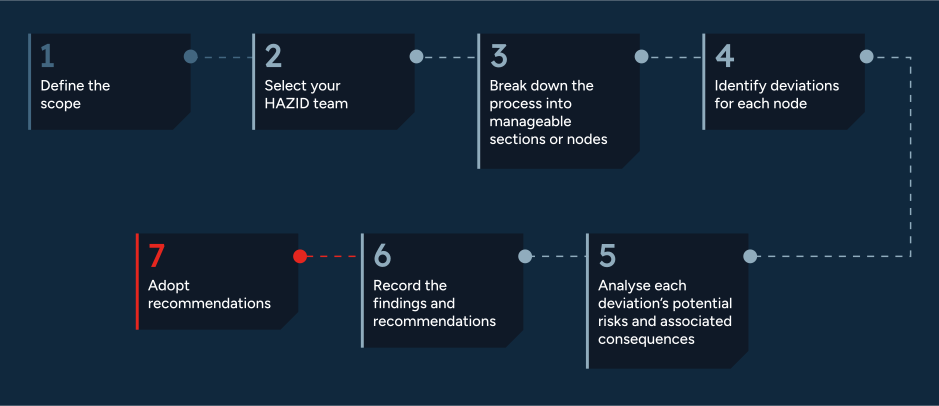
Gexcon facilitates collaborative HAZID workshops, guiding your team through a step-by-step process to ensure all foreseeable hazards are identified and addressed.
Contact usOur approach includes:
- Define the scope
- Clearly define which processes, activities, and areas are to be part of the HAZID study. These processes should be split into logical sections, typically referred to as ‘nodes’.
- Select your team
- A multidisciplinary team with a diverse range of expertise and knowledge related to the process or activity is crucial to the success of a HAZID. The team will typically include Engineers, Operators, Maintenance and QHSE personnel.
- Break down the process
- Divide the process into manageable sections or nodes, each representing a specific element of the system, facility or processes.
- Identify deviations
- For each node, identify deviations from the design objectives by using guide words like “fire and explosion, chemical hazards, and operational hazards”.
- Risk assessment
- Analyse each deviation’s potential risks and associated consequences. For instance, a deviation that leads to a form of injury, death or illness, damage to equipment or environment, operability issues etc. It is crucial to identify existing safeguards and any additional risk reduction measures that may be needed to prevent such scenarios.
- Capture the findings
- Record the findings and recommendations clearly and well organised, ensuring all identified risks are addressed.
- Adopt recommendations
- The details of the HAZID workshop are fully recorded. This document will form the basis for recommending and implementing control measures and risk mitigation strategies.

Value to your business
Our HAZID service helps your business by:
- Detecting potential risks in the early project stages to prevent costly safety issues later
- Supporting informed decision-making to minimise accidents, incidents, and operational disruptions
- Aligning with industry safety regulations and best practices across various sectors
- Developing effective risk reduction strategies to improve operational safety and efficiency
- Providing structured, expert-led hazard analysis to strengthen design, operations, and long-term safety management
Featured Insights
Explore relevant materials providing insights into our service.

HAZID vs. HAZOP: Choosing the right approach for risk assessment
Understand the key differences between HAZID and HAZOP to choose the right assessment method for your project.

The HAZID process for effective hazard identification
See the HAZID process and learn how it helps identify hazards early to improve safety and support better decision-making.

Identification of Major Accident Hazards under COMAH / SEVESO
How to identify major accident hazards at COMAH and Seveso sites using HAZID to meet safety requirements and reduce risks.

Introduction to HAZID (Hazard Identification)
Get an introduction to HAZID: what it is, when to use it, and how it helps identify hazards early in process safety and risk management.
Why choose Gexcon?
At Gexcon, we offer expert services, including facilitation and scribing, to support your HAZID assessment.
Our experienced team ensures that your HAZID studies are conducted efficiently and comprehensively, guiding discussions, capturing critical insights, and documenting findings to help you identify, assess, and address potential hazards at the earliest stages of your project lifecycle.
Need a partner to help drive your project forward?
Our experts are here to help.
Other Process Hazard Analysis Services
Explore our full range of PHA services to help you identify, assess, and manage risks throughout your operations.

Hazard and Operability (HAZOP)
Identify process deviations, assess their causes, and strengthen safety controls to improve operational reliability.

Control Systems HAZOP (CHAZOP)
Identify and evaluate control system risks, from human factors to cyber threats, to ensure safety, reliability, and operability.

What-if Analysis
Identify hazards and failure scenarios early with What-If Analysis – a structured approach that supports proactive risk control and safer decision-making.

Failure Mode and Effects Analysis (FMEA)
Identify failure modes, assess their impact, and prioritise risk mitigation with FMEA to improve safety, reliability, and operational efficiency.

Fault Tree Analysis (FTA)
Identify root causes, evaluate failure scenarios, and apply focused risk controls to improve safety in complex operations.
