Supporting your ATEX Product Compliance
Mechanical and electrical equipment and protective systems intended for use in areas where explosive atmospheres may occur must meet strict safety requirements in line with the ATEX Directive 2014/34/EU (ATEX Product Directive). This ensures they are suitable for their intended use in hazardous environments.
The process of achieving compliance under the ATEX Directive can be complex, particularly when it comes to understanding technical requirements, selecting the right conformity route, and preparing the necessary documentation.
At Gexcon, we support manufacturers through the key stages of the ATEX compliance process for mechanical equipment and protective systems intended for use within potentially explosive atmospheres and explosion protection systems, helping ensure the products are safe, meet requirements, and are ready for the market.
While certification and CE / ATEX marking remain the responsibility of the manufacturer and, where required, may require the involvement of a Notified Body for ATEX certification or storage of documentation, Gexcon provides the technical guidance and testing needed to get you there with confidence.
Whether you’re in the early stages of product development or preparing your Technical File for the Declaration of Conformity, Gexcon can help reduce uncertainty, avoid costly redesigns, and strengthen your case for ATEX Product Directive compliance.
Understanding the ATEX Evaluation and Approval Process
Placing products for use in potentially explosive atmospheres — including mechanical equipment and explosion protection systems — on the European market involves meeting the requirements of the ATEX Directive 2014/34/EU.
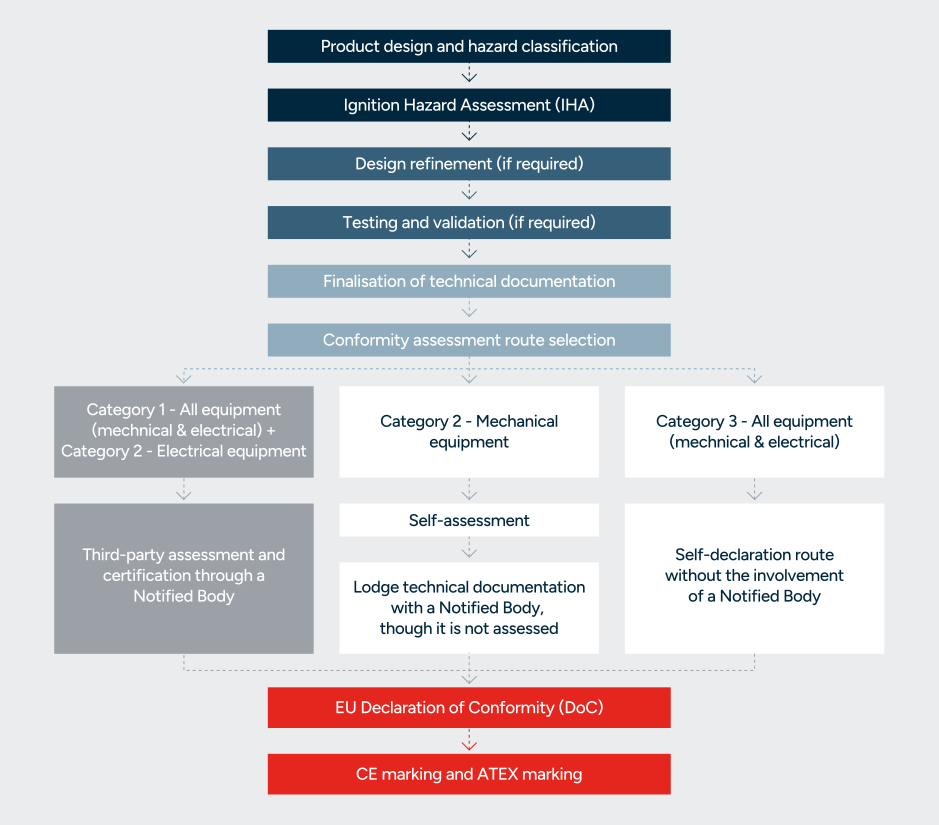
The diagram below shows the simplified overview of steps involved in achieving compliance, from early-stage design through to final CE and ATEX marking.
Gexcon offers a range of services to help guide you through this process efficiently and with clarity.
Services we offer
We provide a comprehensive range of advisory, assessment, and testing services to support you through the ATEX evaluation and approval process, with the aim of preparing a formal Declaration of Conformity.
Our focus is on helping ensure your mechanical equipment and protective systems meet the requirements of the ATEX Directive 2014/34/EU.
The results from our assessments and tests can be used as part of your Technical File and submitted to a Notified Body (where necessary) as a documentation for ATEX approval.
Advisory for Product Design and Hazard Classification
In the early stages of product development, we help manufacturers:
- Determine whether the equipment falls under the scope of the ATEX Directive.
- Identify the appropriate Zone classification and Equipment Category that is required, based on intended use, or can be achieved based on current design/limitations.
- Select relevant harmonised standards and design principles to meet ATEX Essential Health and Safety Requirements (EHSRs).
- Plan the route to conformity to avoid costly redesigns or delays later in the process.
Our early input helps ensure your design aligns with ATEX expectations from the start — similar to how a Notified Body would later review the product.
Ignition Hazard Assessment (IHA)
We conduct systematic ignition hazard assessments in line with:
- EN 1127-1 (Explosive atmospheres — Explosion prevention and protection — Part 1: Basic concepts and methodology)
- This standard describes the general principles of explosion prevention and protection to support the identification of ignition sources and understanding the general explosion risks in potentially explosive atmospheres.
- ISO 80079-37 (Explosive atmospheres — Part 37: Non-electrical equipment for explosive atmospheres — Non-electrical type of protection constructional safety ”c”, control of ignition sources ”b”, liquid immersion ”k”)
- This standard provides additional guidance for mechanical equipment that incorporates specific types of protection.
- ISO 80079-36 (Explosive atmospheres — Part 36: Non-electrical equipment for explosive atmospheres — Basic method and requirements)
- This standard outlines the methodology for identifying and assessing potential ignition sources to ensure that equipment does not become a source of ignition in hazardous environments.
The assessment includes identifying potential ignition sources — such as hot surfaces, mechanical sparks, and electrostatic discharges — and evaluating their presence under normal use, typical/expected fault (or misuse) conditions, or rare fault conditions.
Our IHA reports are suitable for inclusion in your ATEX Technical File or Notified Body submission.

Advisory for Design Refinement
If the Ignition Hazard Assessment identifies the need for product design refinement, we can:
- Advise on suitable ignition barrier concepts for the product.
- Help interpret and apply relevant EN/ISO standards based on the equipment type and use conditions.
- Review updated product designs to ensure identified ignition hazards are addressed.
- Advise on aligning mitigation measures with the product’s ATEX Category and intended Zone of use.
Testing and Validation
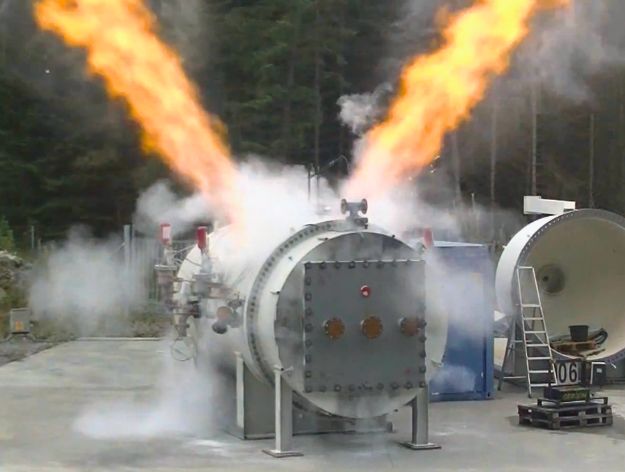
Gexcon performs a wide range of testing to support ATEX compliance. All tests are documented in formal reports suitable for inclusion in ATEX Technical Files.
We also help manufacturers interpret the results so they can refine their designs where needed, particularly if outcomes are borderline or indicate non-compliance.
We conduct ATEX testing for Category 1, 2, and 3 mechanical equipment to support manufacturers during the pre-production or design testing phase. This ensures that equipment meets the required safety standards before proceeding with the Declaration of Conformity.
This step is often important or even critical for mechanical equipment intended for use in Zone 0, 1, or 2 (gas) and Zone 20, 21, or 22 (dust) and is mandatory for explosion protection systems as part of the certification process.
- Determining Maximum Surface / Operating Temperatures
To meet ATEX Directive 2014/34/EU requirements, manufacturers must determine the maximum surface temperature of mechanical equipment to ensure it does not become an ignition source in explosive atmospheres.
As outlined in ISO 80079-36, this involves assessing hot surfaces under both normal and fault conditions, ensuring temperatures stay below the critical or minimum ignition temperatures of flammable substances that can be encountered during use.
Where analytical methods alone are not sufficient, EN 1127-1 supports the use of physical testing to validate surface temperature limits under realistic conditions. These results help determine the equipment’s temperature class for gas zones (T1-T6) or its maximum ignition temperature for dust zones.
This information is essential for selecting equipment suitable for specific hazardous atmospheres and establishing maximum operational temperatures.
- Drop Tests and Mechanical Impact Testing
Ensuring the robustness and durability of equipment intended for use in explosive atmospheres is critical. Drop and mechanical impact tests are essential to verify that such equipment can withstand physical stresses without becoming an ignition source.
The drop tests simulate scenarios where equipment may be accidentally dropped during handling or operation. The equipment is subjected to controlled drops from specified heights to assess its structural integrity and ensure that it is not damaged in a way that could cause sparks or hot surfaces and become a potential ignition source after being dropped. This is particularly important for portable devices like handheld tools.
Mechanical impact tests evaluate the equipment’s resistance to external/accidental impacts that may occur during regular use, such as collisions. The tests involve applying forces to the equipment to ensure it can withstand such impacts without compromising safety. Equipment like enclosures, control panels, and protective housings commonly undergo these assessments.
We conduct systematic drop and mechanical impact tests in line with:
- EN ISO 80079-36: Outlines the basic method and requirements for non-electrical equipment intended for explosive atmospheres, including mechanical strength assessments.
- EN 60079-0: Specifies general requirements for equipment used in explosive atmospheres, encompassing mechanical impact testing where relevant.
- Electrostatic Properties Test
Electrostatic discharge is recognised as a potential ignition source in explosive atmospheres. To prevent this risk, ATEX-compliant mechanical equipment must be assessed for its electrostatic properties, particularly surface resistance and electrical conductivity of any non-conducting parts or materials.
Gexcon supports manufacturers by performing electrostatic properties tests, such as the brush discharge test, in accordance with ISO 80079-36. Additional testing may be necessary in accordance with the standard EN ISO 60079-0 which outlines specific requirements to minimise electrostatic hazards during design, construction, and testing.
This standard requires manufacturers to evaluate whether insulating materials used in equipment could accumulate static charge under normal use. If there’s a risk, surface resistance must be measured. Based on these results, measures such as grounding, bonding, or limiting the use of non-conductive materials may be required.
- ATEX Testing of Explosion Protection Systems
Explosion protection systems form a specialised sub-group of Category 1 mechanical equipment. These systems are specifically designed to mitigate the consequences of explosions and are often subject to demands and requirements given in dedicated standards for testing and conformity assessment.
At Gexcon, we offer dedicated testing services for a range of explosion protection systems, including:
- Explosion mitigation and suppression systems (EN 14373)
- Explosion venting systems (EN 14797)
- Flameless venting systems (EN 16009)
- Fast-acting valves as explosion isolation systems (EN 15089)
- Explosion isolation flap valves (EN 16447)
- Explosion diverters (EN 16020)
- Chemical barriers as explosion isolation systems (EN 15089)
- Flame arresters (ISO 16852)

Advisory and Support on the Finalisation of Technical Documentation
The Technical File is a mandatory requirement under the ATEX Directive and must be retained by the manufacturer for at least 10 years after the final unit is placed on the market.
It serves as documentation that the product meets the essential health and safety requirements and should include a general description of the product, including constructional details, its intended use, and classification (Group, Category, Zone).
In addition, it must contain drawings or diagrams, a list of applied harmonised standards and EHSRs, the Ignition Hazard Assessment, test reports, design calculations, validation records, instructions, marking details, and a copy of the EU Declaration of Conformity (DoC).
To support manufacturers in meeting these documentation requirements, Gexcon can assist in the following ways:
- Provide essential documentation such as:
- Ignition Hazard Assessment reports
- Test result reports
- Evaluation of conformity with EHSRs
- Support in organising and reviewing the Technical File to ensure all required elements are included
- Offer conformity evaluation summaries, which can be used as third-party documentation of due diligence and compliance

Guidance on Conformity Assessment Routes
Gexcon performs a wide range of testing to support ATEX compliance. All tests are documented in formal reports suitable for inclusion in ATEX Technical Files.
We also help manufacturers interpret the results so they can refine their designs where needed, particularly if outcomes are borderline or indicate non-compliance.
We conduct ATEX testing for Category 1, 2, and 3 mechanical equipment to support manufacturers during the pre-production or design testing phase. This ensures that equipment meets the required safety standards before proceeding with the Declaration of Conformity.
This step is often important or even critical for mechanical equipment intended for use in Zone 0, 1, or 2 (gas) and Zone 20, 21, or 22 (dust) and is mandatory for explosion protection systems as part of the certification process.
- Category 1 Mechanical Equipment
Intended for use in Zone 0, 1, or 2 (gas) and Zone 20, 21, or 22 (dust)
Gexcon supports manufacturers in navigating the ATEX Directive 2014/34/EU for mechanical equipment and protective systems. Depending on the equipment category (1, 2, or 3), we can assist in selecting and preparing for the appropriate conformity route.
Our services include:
- Recommend the most suitable and efficient conformity assessment route.
- Explain the requirements for each route.
- Identify when Notified Body involvement is legally required.
- Advise on design or use-case adjustments to potentially simplify the route to compliance.
- Category 2 Mechanical Equipment
Intended for use in Zone 1 or 2 (gas) and Zone 21 or 22 (dust)
While a full third-party assessment is not required, manufacturers must still carry out a self-assessment and lodge the Technical File with a Notified Body.
We can assist by:
- Offering independent reviews to validate internal assessments and demonstrate due diligence
- Supporting the preparation of the Technical File, including drawings, test results, risk assessments, and marking
- Reviewing conformity documentation to ensure it meets ATEX and Notified Body submission standards
- Category 3 Mechanical Equipment
Intended for use in Zone 2 (gas) and Zone 22 (dust)
For this category, manufacturers can follow the self-declaration route. This involves conducting internal assessment and preparing Technical Files without Notified Body involvement. The manufacturer then issues the EU Declaration of Conformity (DoC).
We can help by:
- Offering independent reviews to validate internal assessments and demonstrate due diligence
- Advising on the correct structure and content of the Technical Files
- Supporting compliance checks against harmonised standards and applicable EHSRs

Assistance with the EU Declaration of Conformity
The manufacturer is responsible for preparing and signing the EU Declaration of Conformity (DoC), a formal statement confirming that the product meets the requirements of the ATEX Directive 2014/34/EU.
This document must include details such as the manufacturer’s name and address, product identification, a declaration of compliance with relevant directives and harmonised standards, and—if applicable—the name and number of the Notified Body. It must be signed by a responsible person and kept with the Technical Files, ready to be provided to customers or authorities upon request.
While Gexcon does not sign the DoC or take direct responsibility for it, we can support by:
- Ensuring all technical requirements are properly addressed and documented
- Providing the documentation base, such as test results and ignition hazard assessments, to justify the manufacturer’s declaration
- Reviewing the declaration text to ensure it aligns with the selected conformity assessment route

Support during CE and ATEX Marking Stage
CE and ATEX markings are required before equipment and protective systems to be used in a potentially explosive atmospheres can be legally placed on the EU market. While applying the marking is the manufacturer’s responsibility,
Gexcon can support the process by:
- Ensuring that all supporting documentation has been reviewed and verified prior to marking
- Helping manufacturers confirm that the marking is correct for the equipment’s classification and conformity assessment route
- Providing guidance on the correct format and wording of the marking as part of the overall conformity process
Frequently asked questions
As of 20 April 2016, ATEX Directive 2014/34/EU replaced the previous Directive 94/9/EC. To ensure compliance with the current directive, manufacturers should consider:
- Updating the Declaration of Conformity (DoC): For products placed on the market from 20 April 2016 onwards, the DoC must reference Directive 2014/34/EU instead of 94/9/EC (along with valid associated standards).
- Reviewing and revising technical documentation: Ensure that all technical files and supporting documents align with the requirements of Directive 2014/34/EU.
- Assessing existing certifications: Certificates issued under Directive 94/9/EC remain valid under 2014/34/EU. However, any modifications to the product or its intended use may necessitate re-evaluation and possible re-certification under the new directive.
- Ensuring traceability and marking compliance: Verify that product markings, including the CE and Ex symbols, and traceability information meet the specifications outlined in Directive 2014/34/EU.
- Engaging with Notified Bodies if necessary: For products requiring third-party assessment, coordinate with a Notified Body to obtain the appropriate certification under Directive 2014/34/EU.
According to Annex II. 1.0.1 of the ATEX Directive 2014/34/EU, equipment and protective systems intended for use in potentially explosive atmospheres must be designed from an integrated explosion safety point of view. Therefore, the equipment manufacturer must ensure the following details:
- Prevent the equipment and protective systems from generating explosive atmospheres or triggering explosions
- Prevent the equipment and protective system from becoming an effective ignition source in the explosive atmospheres where they are intended to be used
- If an explosion should occur, the equipment and protective system should be designed and used such that it is able to halt immediately and/or limit the consequence of the explosion overpressures to a sufficient level of safety
According to Article 1(1), Chapter 1 of the ATEX Directive 2014/34/EU, the directive applies to the following types of equipment:
- Mechanical and electrical equipment and protection systems intended for use in potentially explosive atmospheres.
- Safety, controlling, and regulating devices intended for use outside potentially explosive atmospheres but essential for the safe operation of equipment and protection systems concerning explosion risks.
- Components intended to be incorporated into the equipment and protection systems as mentioned in the first point.
According to Article 2 of the ATEX Directive 2014/34/EU, “intended use” refers to the use of a product specified by the manufacturer by assigning the equipment to a particular equipment group and category, or by providing all necessary information to ensure the safe operation of a protective system, device, or component.
To define the intended use, the following must be considered:
- The type of explosive atmosphere the equipment will be exposed to — whether internally, externally, or both — such as gas/vapour/mist or dust.
- The Zone classification — whether the area is Zone 0/20, 1/21, or 2/22, which reflects how often and how long the explosive atmosphere may be present.
- Environmental factors — such as temperature, pressure, vibration, and humidity.
- Expected operation — including normal use, potential faults, and how the equipment interacts with other systems.
Understanding the intended use is important because it helps determine:
- The ATEX Equipment Category (1, 2, or 3) required.
- The level of protection that must be built into the equipment.
- Whether the equipment needs to go through third-party certification or whether it can be self-assessed and declared by the manufacturer.
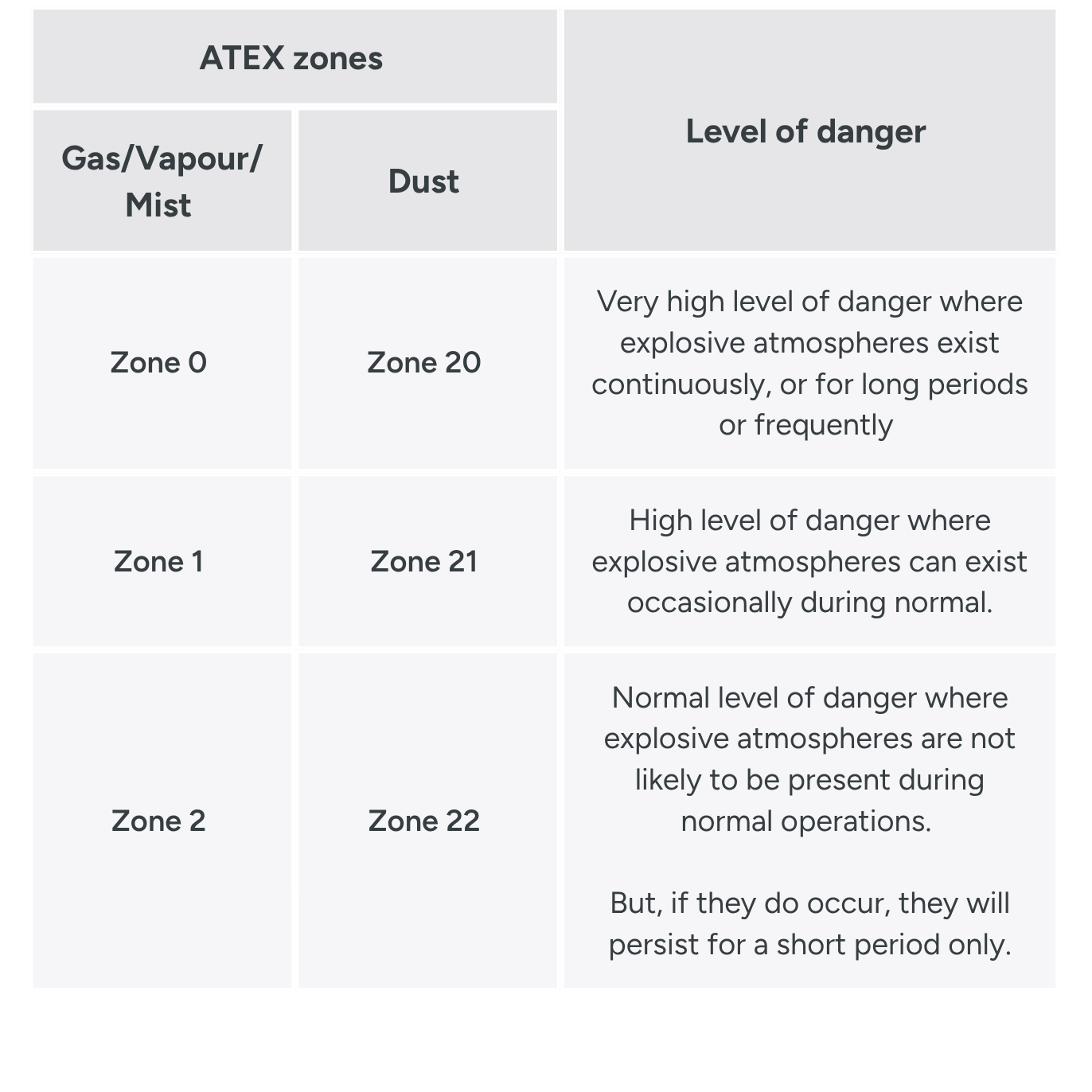
According to the ATEX Workplace Directive (1999/92/EC), workplaces must classify industrial plant and process areas where potentially explosive atmospheres can exist into “hazardous zones” on the basis of the frequency and duration of the occurrence of an explosive atmosphere.
The Directives distinguish between two main types of explosive atmospheres: gas/vapour/mist and dust.
According to Annex I. 2. of the ATEX Directive 1999/92/EC, the hazardous zones for the two types of explosive atmospheres are defined as shown on the table alongside.
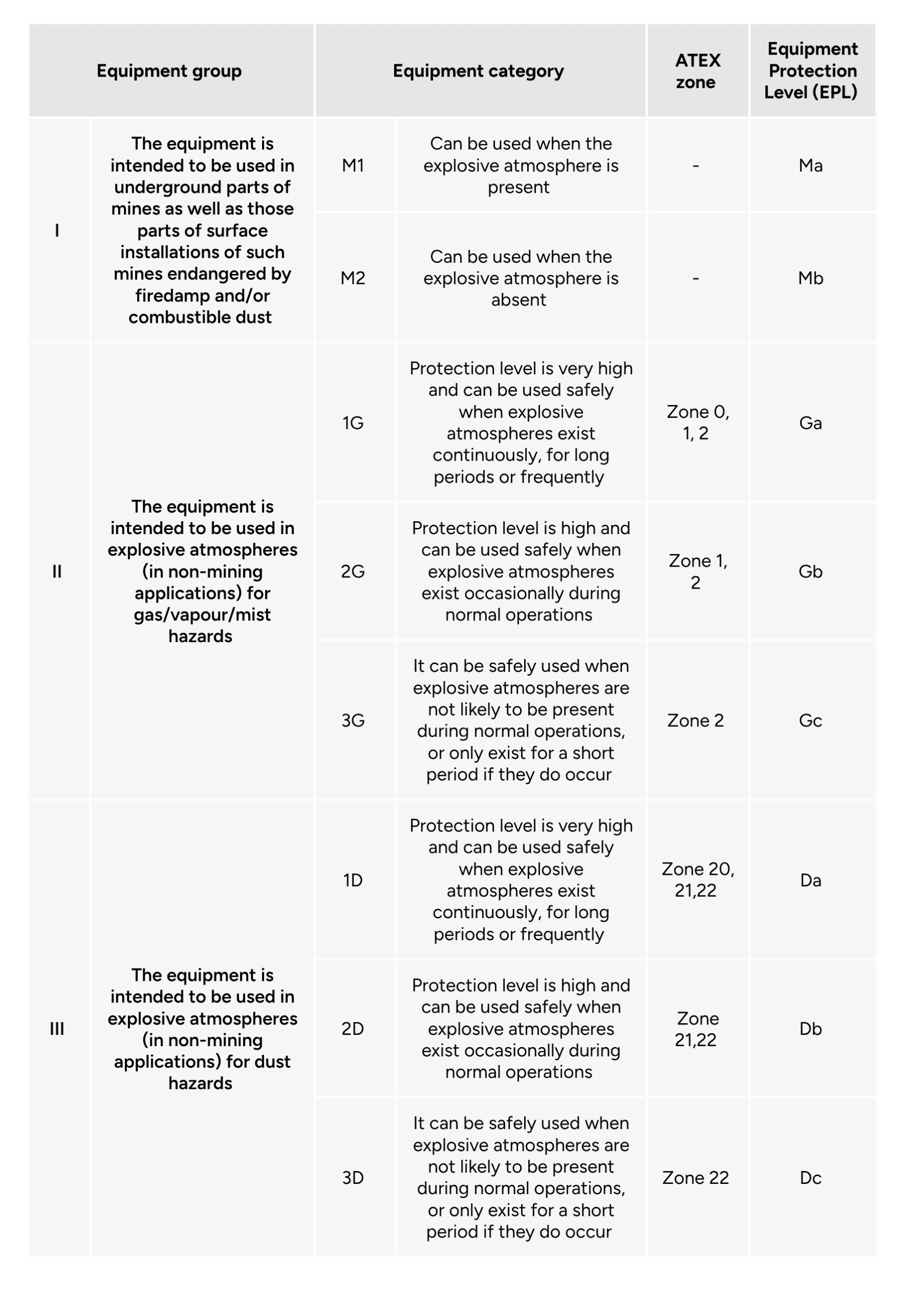
The ATEX Directives divide ATEX equipment into groups and categories to accommodate each ATEX zone.
Please refer to the table alongside for more information.
The required level of safety for protective systems depends on how likely it is that a flammable atmosphere will be present. The greater the likelihood, the more stringent the safety requirements for equipment used in that area.
If an explosion does occur and could directly or indirectly endanger people, animals, or property, the protective systems must be able to stop it immediately and/or limit the spread of flames and pressure to a safe level.
Protective systems must also be designed to reduce the impact of an explosion to a sufficient level of safety.
Value to your business
Our ATEX Product Testing and Compliance services help manufacturers ensure that their equipment and protective systems are suitable for use in explosive atmospheres.
By working with us, you benefit from:
- Meeting regulatory requirements under the ATEX Directive 2014/34/EU, allowing your products to be placed on the EU market.
- Demonstrating the safety and robustness of your equipment through verified testing, supporting your CE and ATEX marking process.
- Identifying potential ignition hazards early in the design or development phase, reducing costly redesigns or delays.
- Building trust with your customers by showing that your products meet recognised safety standards and have undergone independent testing.
- Supporting your technical documentation and Declaration of Conformity with credible test results that align with harmonised standards.
Featured Insights
Explore relevant materials providing insights into our service.
Introduction to ATEX Directives
Learn the basics of ATEX Directives, their role in managing explosive atmospheres, and what they mean for equipment and workplace safety.
Ignition hazard analysis and the hidden threats posed by mechanical equipment handling bulk solids
Learn why ignition hazard analysis is critical for bulk solids safety and how mechanical equipment may become an ignition source.
How to perform an Ignition Hazard Assessment (IHA)
Learn how to perform Ignition Hazard Assessments and the processes involved in issuing self-declarations depending on the classification of the hazardous area.
Validate your project with proven test data
Work with our specialists to get insights you need for smarter decisions.
