The Minimum Ignition Energy (MIE) test measures the smallest amount of energy needed to ignite a dust cloud.
This test helps assess how sensitive a material is to ignition from electrostatic discharges or electrical equipment.
Knowing the MIE value of your dust is important when designing safe processes, selecting equipment, or putting control measures in place to reduce the risk of explosion.
Why MIE Testing Matters
MIE values usually range from 1 mJ to 1000 mJ. A lower value means the dust is more easily ignited – even a small spark could cause an explosion. Knowing the MIE of your dust is important for:
- Designing equipment that won’t create ignition sources
- Putting proper grounding and bonding in place
- Choosing the right dust collection and handling systems
- Reducing the risk of fire or explosion in the workplace
Examples of MIE for Common Workplace Materials
These values can vary depending on factors such as particle size, moisture content, and how the material is made. For reliable safety decisions, standardised testing or detailed technical data should be used.
This table shows that materials behave differently and highlights the need for testing to set the necessary safety measures for your specific process.
Examples of MIE for Common Workplace Materials
| Substance | Typical MIE (mJ) | Hazard Level |
|---|---|---|
| Aluminum | 1–10 | Very High |
| Wood | 10–30 | High |
| Cellulose | 30–50 | Moderate |
| Flour | 50–100 | Moderate to Low |
| Plastic | 100–500 | Low |
Testing Methodology
Gexcon performs Minimum Ignition Energy (MIE) testing in line with the European standard EN ISO/IEC 80079-20-2:2016 “Explosive atmospheres – Part 20-2: Material Characteristics – Combustible dust test methods”.
Dust samples are dispersed into a cloud within a 1.2-litre vertical tube using either the Modified Hartmann or MIKE3 apparatus. The cloud is then exposed to sparks of different energy levels to find the lowest energy that can cause ignition.
Testing can be done with or without inductance in the ignition circuit.
We use the Modified Hartmann apparatus to test spark energies of 2, 5, 10, 15, 20, 50, 100, 200, and 2000 mJ (with inductance).
We use the MIKE3 apparatus to test spark energies of 1, 3, 10, 30, 100, 300, and 1000 mJ (with or without inductance).
Testing Options: With or Without Inductance
The MIE test can be performed with or without inductance in the ignition circuit. Each method simulates different types of ignition sources commonly found in industrial environments.
If you’re unsure which method suits your needs, contact us for advice on selecting the right testing approach for your process.
Value to Your Business
- Supports practical decisions on whether electrostatic or mechanical ignition sources pose a real risk in your process
- Helps reduce costly overengineering by providing clear data on ignition sensitivity
- Offers a reliable basis for setting safe handling and housekeeping procedures when working with fine powders
- Provides confidence when selecting or certifying equipment for use in dust-prone areas
- Can inform zoning decisions and documentation under ATEX, DSEAR, or similar regulations
Featured Insights
Explore relevant materials providing insights into our service.

Dust explosion: an introduction
Learn what causes dust explosions, why they’re dangerous, and how to reduce the risk in industrial environments.
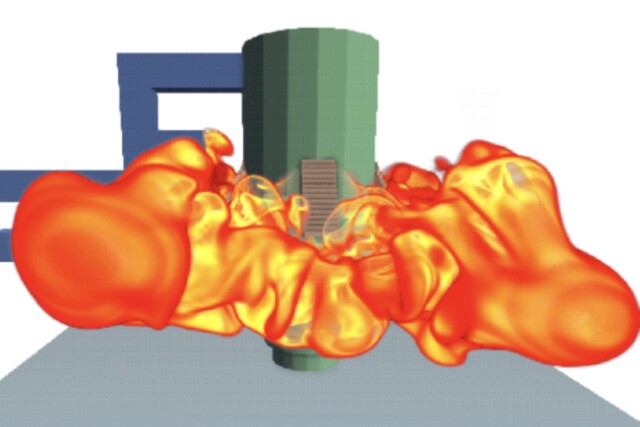
Investigation Findings And Lessons Learned In The 2014 Georgia Pacific Corrigan Facility Fire And Explosion
This paper discusses the proximate causes of the 2014 Georgia Pacific Corrigan Facility fire and explosion and its root causes.
How to properly design your dust explosion protective systems
Learn how poor dust system design led to a major plant explosion and what steps to take to prevent similar combustible dust incidents.
Dust hazard analysis and prevention, the hierarchy of controls, and practical implementation
Learn the practical steps to assess fire and explosion risks from bulk solids and demonstrate ALARP for regulatory and standard compliance/

Fundamentals of fire and explosion from handling bulk solids
Learn how to assess and prevent fires and explosions from flammable bulk solids.
Validate your project with proven test data
Work with our specialists to get insights you need for smarter decisions.
Comprehensive combustible dust testing services
- Explosibility Screening Test (Yes/No) Read more
- Minimum Ignition Energy (MIE) of Dust Cloud Test Read more
- Minimum Ignition Temperature (MIT) of Dust Cloud Test Read more
- Minimum Ignition Temperature (MIT) of Dust Layer Test Read more
- Explosion Severity Test (Pmax, dP/dt, KST) Read more
- Lower Explosion Limit Test (LEL, MEC) Read more
- Limiting Oxygen Concentration (LOC) Test Read more
- Burning Behaviour Test Read more
- Dust / Powder Resistivity Test Read more
- Hot Storage Test in Wire Baskets (Self-Ignition Temperature) Read more
- Electrostatic Hazard Tests Read more
- UN Transportation Tests (UN Class 4) Read more
