The Burning Behaviour test evaluates whether a dust continues to burn after ignition and determines the severity of combustion propagation through a material deposit.
The material’s burning behaviour is numerically rated from 1 to 6, as defined by test standards.
This rating system provides a Combustibility Class (CC) to help characterise the material’s combustion risk. Testing is performed under both ambient and elevated environmental temperature conditions for a comprehensive assessment.
Why Burning Behaviour Test Matters?
The Burning Behaviour Test helps you understand how dust reacts after ignition, whether it smoulders, glows, or burns rapidly. This insight is key to preventing fire spread, identifying hidden ignition risks, and selecting the right safety measures.
It also supports correct material classification for handling, transport, and compliance with fire safety standards.
Contact usExample Burning Behaviour for Common Dusts
| Type of Reaction | CC | Reference Product |
|---|---|---|
| No spreading of fire No Ignition | 1 | Salt |
| Brief ignition and rapid extinction | 2 | Citric Acid |
| Localised combustion or glowing with practically no spreading | 3 | Cornstarch |
| Fire spreads Glowing without sparks (smouldering) or slow decomposition without flame | 4 | Charcoal |
| Burning with flame or spark generation | 5 | Magnesium |
| Very rapid combustion with flame propagation or rapid decomposition without flame | 6 | Nitrocellulose |
Testing Methodology
- The test is carried out in accordance with the European standard, NS-EN 17077:2018, “Determination of Burning Behaviour of Dust Layers”
The NS-EN 17077:2018 test method assesses the burning behaviour of dust layers by placing a prepared sample, typically sieved to ≤ 250 µm and dried, into a thin layer on a non-combustible surface. A steady airflow (around 0.2–0.4 m/s) is applied to simulate real-world conditions, and the sample is ignited using a glowing wire or small flame for 5–10 seconds. The test then observes whether the material smoulders, burns with or without flame, generates sparks, or combusts rapidly. Based on the outcome, the material is assigned a Combustibility Class from 1 (no ignition) to 6 (very rapid combustion).
Value to Your Business
- Rating dust from Class 1 to 6 helps you see how likely a fire is to spread, so you can tailor fire safety systems effectively
- Knowing burning behaviour helps you assess threats from hot embers or friction and prevent small ignitions from becoming full-scale fires
- Testing under NS-EN 17077:2018 helps you show regulators and insurers that fire hazards are quantified and controlled
- Using accurate Combustibility Class data helps you invest only in protection systems that match actual fire risk and avoid overspending
- Understanding burning severity helps you design procedures and controls that stop fire escalation and protect people, property, and uptime
Featured Insights
Explore relevant materials providing insights into our service.

Dust explosion: an introduction
Learn what causes dust explosions, why they’re dangerous, and how to reduce the risk in industrial environments.
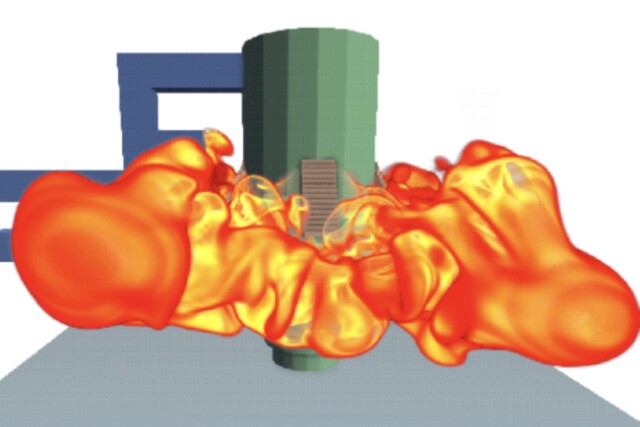
Investigation Findings And Lessons Learned In The 2014 Georgia Pacific Corrigan Facility Fire And Explosion
This paper discusses the proximate causes of the 2014 Georgia Pacific Corrigan Facility fire and explosion and its root causes.
How to properly design your dust explosion protective systems
Learn how poor dust system design led to a major plant explosion and what steps to take to prevent similar combustible dust incidents.
Dust hazard analysis and prevention, the hierarchy of controls, and practical implementation
Learn the practical steps to assess fire and explosion risks from bulk solids and demonstrate ALARP for regulatory and standard compliance/
Fundamentals of fire and explosion from handling bulk solids
Learn how to assess and prevent fires and explosions from flammable bulk solids.
Validate your project with proven test data
Work with our specialists to get insights you need for smarter decisions.
Comprehensive combustible dust testing services
- Explosibility Screening Test (Yes/No) Read more
- Minimum Ignition Energy (MIE) of Dust Cloud Test Read more
- Minimum Ignition Temperature (MIT) of Dust Cloud Test Read more
- Minimum Ignition Temperature (MIT) of Dust Layer Test Read more
- Explosion Severity Test (Pmax, dP/dt, KST) Read more
- Lower Explosion Limit Test (LEL, MEC) Read more
- Limiting Oxygen Concentration (LOC) Test Read more
- Burning Behaviour Test Read more
- Dust / Powder Resistivity Test Read more
- Hot Storage Test in Wire Baskets (Self-Ignition Temperature) Read more
- Electrostatic Hazard Tests Read more
- UN Transportation Tests (UN Class 4) Read more
