
FLACS for safety assessments
FLACS is widely used by safety engineers and consultants to model and assess hazards in facilities handling flammable or toxic substances.
By simulating real site conditions, it helps you understand how releases, fires, and explosions may develop and what measures can reduce the risks.
Use case examples
See practical examples below to learn how FLACS can support safer designs and smarter decisions.
Designing effective ventilation for a containerised hydrogen compressor system
Approach
Test different ventilation configurations to see how airflow patterns influence gas build-up. The goal is to design a system that disperses leaks quickly and lowers explosion risk.
Benefit
Provide guidance on ventilation design and optimal roof vent placement to limit the reactivity and volume of a flammable hydrogen cloud and the time it is present for.
Optimising gas detector layouts using CFD
Approach
Simulate realistic leak scenarios—including varying gas types (light, heavy, diffusive, jets), equipment congestion, ventilation, wind speed, and terrain—to assess how these factors affect gas dispersion and detector performance.
Benefit
Maximise detector coverage while reducing numbers, helping you meet safety targets and lower both installation and maintenance costs. This creates a system that detects hazards more reliably and more efficiently.
Designing safer battery energy storage systems (BESS)
Approach
Simulate how a thermal runaway consequences develops in a BESS installation, whether it starts in a single cell, spreads across modules, or escalates to system-wide failure under real-world conditions
Benefit
Support safe BESS design by guiding layouts and equipment arrangements to minimise fire impact, Assessing effectiveness of passive fire protection measures, and determining if neighbouring battery cells can withstand the heat load from a large-scale fire.
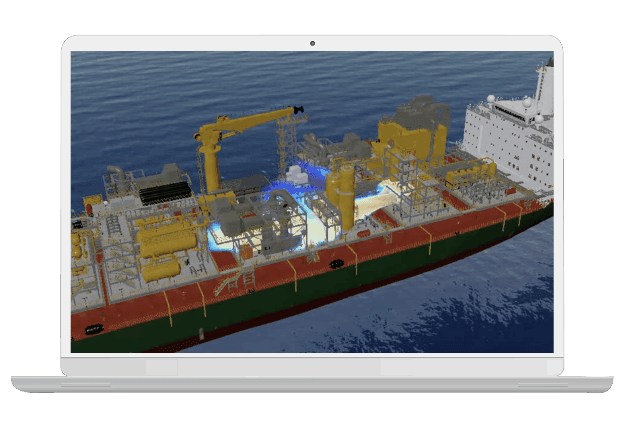
Developing reliable evacuation plans on an FPSO in case of a H2S leak
Approach
Model outdoor hydrogen sulphide releases under different weather conditions to see how the gas disperses and where it accumulates.
Benefit
Define hazard zones around the FPSO and guide emergency planning, including evacuation distances.
Supporting ammonia storage and transport projects for the energy transition
Approach
Assess high-pressure ammonia leaks by simulating different scenarios, such as a puncture or a full-bore rupture at varying heights and wind conditions.
Benefit
Understand exposure zones to inform safety controls – such as establishing drainage areas exclusion zones and planning emergency response.
Reconstructing accidents to support incident investigations
Approach
Recreate the sequence of events in incidents involving explosions, fires, or toxic releases. Simulations account for site-specific factors such as equipment layout, weather conditions, and ignition sources to replicate what happened as accurately as possible.
Benefit
Provide clear science-based evidence to identify root causes, support expert witness testimony, and inform corrective actions that can prevent similar incidents in the future.
Assessing explosion risks to guide LNG facility siting
Approach
Simulate potential LNG releases, dispersion patterns, and ignition scenarios to determine VCE overpressures under different layouts and congestion levels.
Benefit
Inform safe separation distances, optimise placement of occupied buildings, and ensure adjacent facilities or the public are at a safe distance. Supports siting decisions for new and modified installations and helps minimise explosion risk through smarter facility design.
Improving venting equipment design and safety for dust explosions in filter systems
Approach
Simulate dust explosions inside industrial filter units, considering dust concentration, ignition location, and venting arrangements. Model pressure rise and flame spread to understand potential failure points.
Benefit
Support safer filter design, confirm explosion vent capacity, and optimise protection measures to reduce damage and improve safety in combustible dust handling facilities.
More ways FLACS is used
FLACS goes beyond the examples mentioned and enables analysis of a broad range of applications, including:
- Worst-case or realistic worst-case explosion analysis
- Explosion Risk Assessment (ERA)
- Fire Risk Assessment (FRA)
- Probabilistic fire and explosion analysis
- Blast propagation
- Dust explosion risk assessments
- Cryogenic releases
- Exhaust fume and flare design
- Helideck or crane siting
- Smoke modelling and escape route impairment
- Consequence assessments for energy transition projects, including:
- hydrogen production facilities and refuelling stations
- biomass and biofuel facilities
- battery energy storage systems (BESS)
Would you like to know more about FLACS?
View our case studies or fill in the enquiry form to get in touch.
View case studies