
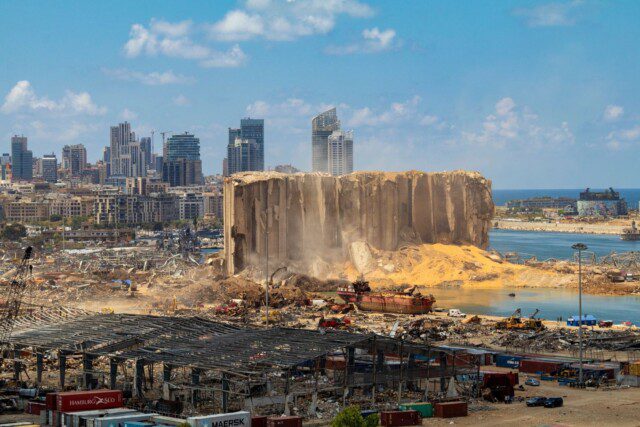
While ammonium nitrate is noncombustible, it has a melting point near 170oC. Once heated past its melting point by an external heat source (e.g. a nearby fire), the decomposition reactions are all exothermic thus they all contribute to heat generation, further melting the solid ammonium nitrate, and presenting possible runaway conditions. This may lead to the explosive detonation reaction seen in the port of Beirut, the port of Tianjin, and West, Texas.
The resultant release of energy may generate a temperature rise of approximately 1,800°C to 2,000°C (3,272°F to 3,632°F) in the immediate vicinity. The rapid volume increases from near instantaneous expansion of gasses will typically produce a shock wave that can result in considerable area damage.

Despite the potentially hazardous decomposition of ammonium nitrate, large scale burn tests involving several tons of ammonium nitrate have not resulted in an explosion decomposition. FM Global reports that there have been a number of fire incidents involving quantities of ammonium nitrate exceeding 50 tons, which only burned and did not result in an explosion. Data suggests that detonations are promoted by severe shock or by heating with confinement.
The sensitivity of ammonium nitrate to explosion increases with the presence of organic material such as oil, sulfur, grease, charcoal, and combustible dust.
So, what can we do to prevent and mitigate these events? Find out in the third part of our ammonium nitrate blog.

Would you like to learn more about this topic?
Watch a video where Dr. Davis explains the conditions that allow ammonium nitrate to explode and cause destructive consequences.
He also talks about mitigation measures to reduce the risk of ammonium nitrate explosions.
Authors

Scott G. Davis, Ph.D., P.E., CFEI
US CEO – Principal Engineer at Gexcon
Related insights
Browse additional insights to deepen your understanding and stay informed on related topics.
Learning from ammonium nitrate explosion incidents
Ammonium nitrate is stable, but bulk storage near fire hazards can lead to major explosions despite long-known safety risks.

Unraveling the mysteries of ammonium nitrate detonations
Learn how to prevent ammonium nitrate incidents by understanding the conditions that lead to explosive decomposition and how to avoid them.
How dangerous is ammonium nitrate?
Ammonium nitrate is used worldwide as fertilizers. Even though it is non-combustible in most conditions, it can have a devastating effect.

How to prevent and mitigate against ammonium nitrate explosions?
Learn how to reduce the risk of ammonium nitrate explosions through safer storage, fire prevention measures, and risk awareness.
Beirut port explosion: What we know from previous explosions caused by ammonium nitrate
What lessons can we learn from past ammonium nitrate explosions, such as the Beirut Incident to prevent future disasters?
Stay ahead in process safety and risk management
Get the latest trends in the field of process safety management straight to your inbox, and enhance your skills through knowledge sharing from industry experts.
Subsribe to our newsletter