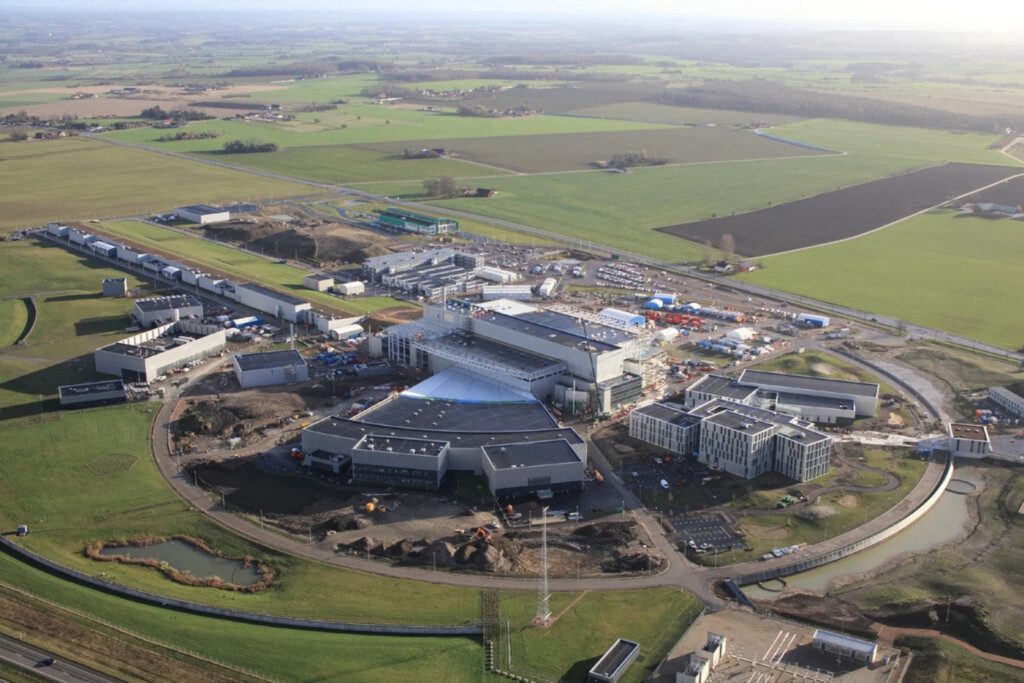
(Banner image courtesy of Perry Nordeng/ ESS)
The challenge
ESS is a neutron source facility for the study of materials at molecular and atomic levels, which will enable applications in materials research in fields such as medicine, biology, chemistry, physics, geology, and engineering.
The facility design and construction include a linear proton accelerator (consisting of two parts, a Normal Conducting Linac (NCL) and a Superconducting Linac (SCL), among many others.
The accelerator is built in a tunnel (confined space) 3-4 meters below the ground. ESS will extract protons from hydrogen gas stored under pressure in a storage bottle with the help of an electromagnetic field for the accelerator. The hydrogen bottle is stored in a semi-confined compartment to control gas spread in case of leakage.
Due to hydrogen’s flammability properties, the Swedish Rescue Services requires ESS to assess the extent of a potential accidental hydrogen release inside the accelerator tunnel.
The extent of the flammable cloud from the hydrogen release needs to be fully understood so that ESS can identify ATEX zones and implement the necessary preventive and mitigative measures to comply with area classification and personnel safety regulations.
The approach
Considering the confinement and the complex geometry of the system under investigation, Gexcon performed a set of 3D pressurised gas release and dispersion simulations to characterise the extent and behaviour of the flammable cloud originating from the hydrogen gas storage within the ion source of the accelerator.
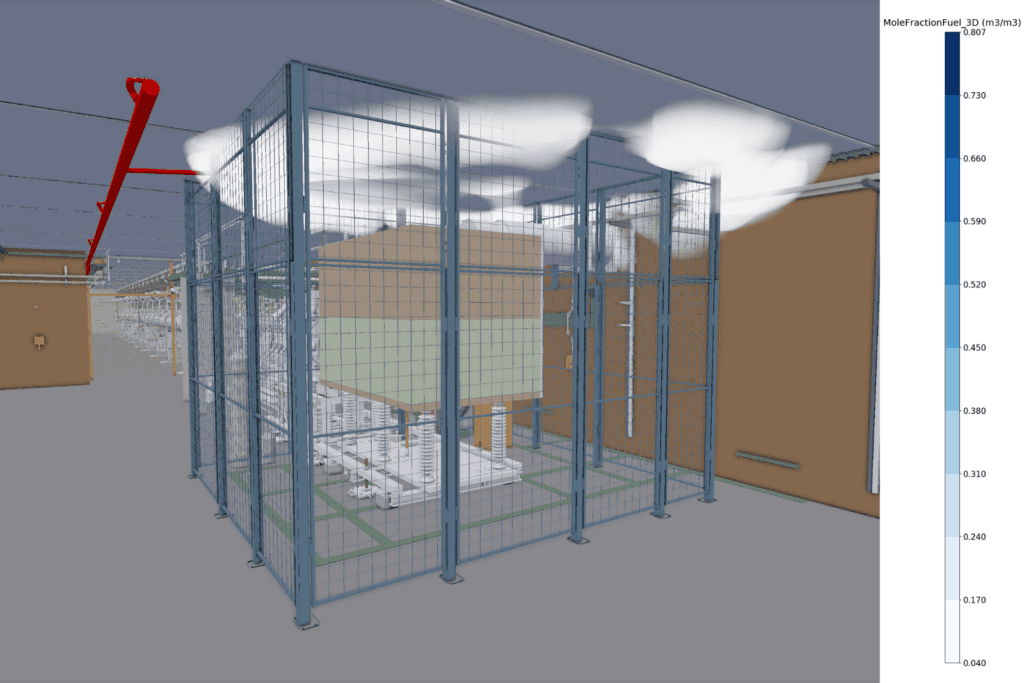
Our consulting team worked closely with ESS representatives to ensure all information and inputs were well-received to adopt necessary assumptions for the assessment.
FLACS 3D consequence modelling software was chosen as the tool for the study due to the following background:
- The proton accelerator is located within a confined space (a tunnel).
- The compartment where the hydrogen bottle is stored has a semi-confined design.
- The pressurised release of hydrogen may show specific buoyant behaviour.
- There are ventilation systems installed within the tunnel that will affect both the transport and the dilution of the cloud.
This is because FLACS accounts for complex geometry aspects, such as facility layout and site congestions, and input data based on the facility’s environment, such as ventilation conditions.
Therefore, the results generated from the software are reliable and more accurate.
The outcome
The results of our assessment have been presented to the Swedish Rescue Services and were well received. At the same time, ESS obtained a deeper insight into the hydrogen hazards in the facility.
- Accurate ATEX zone prediction
- The size, location, and concentration distribution of the flammable cloud from the hydrogen release are accurately predicted by FLACS. Therefore, the extent of the ATEX zones is well understood and becomes a basis for ESS to implement the necessary preventive and mitigative measures.
- Improved safety awareness through visualisation
- Detailed 3D visualisation of the hydrogen gas cloud is an effective tool for communication and increased safety awareness.
- Insights to adjust operational conditions
- The sensitivity studies have provided a more profound perception of hydrogen hazards in the facility and how to adjust process conditions to mitigate and manage the risk during the operational phase.
- Trusted expertise and practical guidance
- Because of the Gexcon consulting team’s involvement in many hydrogen safety-related projects globally, we are able to provide sound theoretical and practical insights and recommendations.
- Efficient and cost-effective support
- Our extensive experience allows our team to work effectively, thus providing ESS with cost-effective and time-efficient solutions.
Insights from the project
- Accurate geometry matters
- Realistic geometry modelling of installations has significant influences on the accuracy and reliability of the results.
- Impact of confinement and ventilation
- Confinement and ventilation can influence the gas dispersion behaviour.
- Better risk understanding through realistic dispersion modelling
- Realistic modelling of hydrogen gas dispersion improves the understanding of risk and gives better decision support for the cost-effective implementation of preventive and mitigative measures in the facility.
About ESS
European Spallation Source (ESS) is an international project with 13 European member nations, organised as a European Research Infrastructure Consortium (ERIC).
Need a partner to help drive your project forward?
Our experts are here to help.
Relevant solutions
Facility Layout Optimisation and Verification
Develop safer, compliant facility layouts by identifying hazards early, avoiding costly redesigns, and minimising risks through expert analysis.

ATEX Compliance
Get expert support to meet ATEX regulations, control workplace hazards, and reduce the risks of flammable gases and combustible dust.

Consequence and Impact Modelling
Helping you assess the consequences of potential hazardous events and plan how to manage them.
FLACS
Advanced CFD tool for simulating fires, explosions, and gas dispersion in complex environments.
