
The challenge
An existing plant that traditionally manufactured water-based products containing very minor quantities of flammable materials was being repurposed to manufacture a hand sanitiser that contains a significant proportion of (highly flammable) alcohol.
This product was to be brought online rapidly, to meet the urgent international requirements due to the 2020 Covid-19 crisis.
An initial assessment identified that without mitigation, mixing tanks would always contain a flammable atmosphere. If this flammable atmosphere was ignited, the explosion would split the tank and propagate the effects of this into the working area, resulting in serious injuries or fatalities.
The conventional way of mitigating this risk would be to blanket the tank with an inert gas, working below the limiting oxygen concentration (LOC). To achieve this, the mixing tank could be sealed, or replaced with one which could be sealed, and an inert gas system would need to be installed along with a process monitoring and control system.
The urgency with which the product needed to be produced precluded this time-intensive approach.
We investigated the effects of ventilation on the flammable atmosphere inside the tank under specified manufacturing conditions. The intention was to assess the effect that dilution ventilation would have on the vapour/air concentrations in the tank.
The approach
A 3D modelling study was conducted using FLACS. Different scenarios (such as product loads/levels) were assessed and the impact of varying ventilation rates on the atmosphere within the mixing tank was considered. This determined the minimum ventilation rate required to guarantee that a flammable atmosphere could not be formed within the mixing tank.
The ventilation and dispersion modelling study identified that solvent vapour concentration within the mixing tank could be held below the lower explosive limit (LEL)in different scenarios. Increasing the ventilation rate allowed vapours to be below 50% (or even 25%) of the LEL, providing an extra safety gap in the manufacturing conditions.
The outcome
FLACS modelling confirmed that dilution ventilation could be used as a basis of safety.
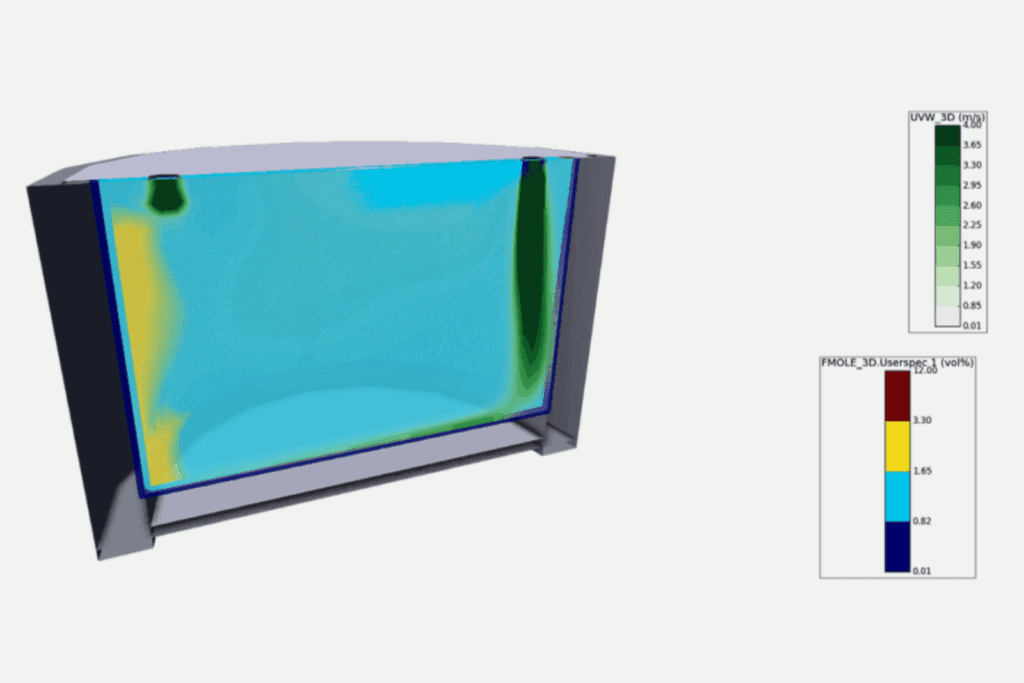
As shown in Figure 1, FLACS dispersion modelling results were used to determine the extraction fan ventilation rates required to avoid the presence of a flammable atmosphere within a stirring tank.
The figures show how ethanol vapour concentrations FMOLE_3D (vol%) and the air velocity, UVW_3D (above)/VVEC_3D evolve over time and demonstrate that vapour concentrations remain below the lower flammability limit (3.3% volume in the air for ethanol) for the proposed extraction rate.
A BowTie study was used to demonstrate how robust it was, and what additional layers of protection were needed.
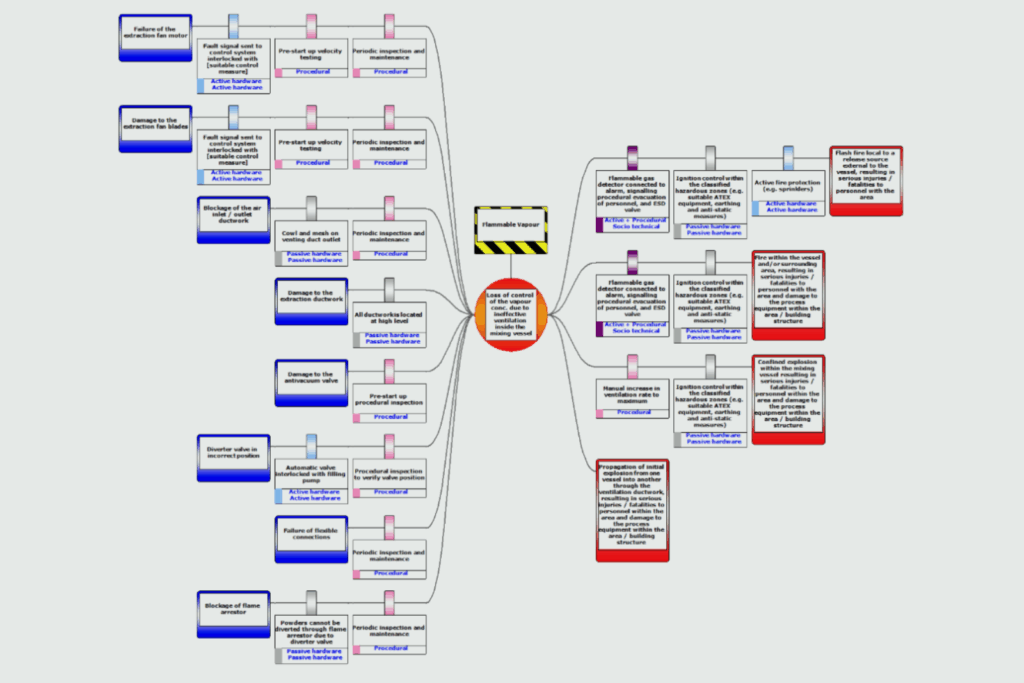
The study showed that this approach relies heavily on safe operating procedures and requires intensive operator training. Due to the urgent requirement and the short nature, this was an acceptable approach to ensure safety concerns had been addressed.
Benefits for the client
The outcomes of this analysis supported the client within the following aspects:
- Demonstrating safe dilution ventilation
- The detailed 3D CFD modelling of vapour dispersion provided a clear demonstration that dilution ventilation can be used to guarantee a flammable atmosphere could not be formed within the mixing tanks.
- Determining ventilation requirements
- The modelling permitted the required ventilation rates needed to be determined.
- Integrating procedural safety through BowTie analysis
- Using the BowTies study, we demonstrated what additional measures (such as strict operating procedures) would be required to guarantee that safety was robust.
- Rapid and safe manufacturing
- Quick and practical advice (evidenced by state-of-the-art FLACS modelling) permitted manufacturing to start safely on a timescale to meet the urgent international requirement.
- Validating the combined safety approach
- The use of FLACS, combined with Gexcon’s experience and engineering judgment, permitted the client to clearly demonstrate that the proposed approach of using dilution ventilation combined with training and strict operating procedures would allow the product to be manufactured safely.
About our client
A major UK manufacturer began production of hand sanitiser to meet urgent international requirements due to the Covid-19 crisis.
Need a partner to help drive your project forward?
Our experts are here to help.
Relevant solutions
DSEAR Compliance
Ensure DSEAR compliance, manage hazardous substance risks, and reduce fire and explosion hazards to keep your workplace safe.
Facility Layout Optimisation and Verification
Develop safer, compliant facility layouts by identifying hazards early, avoiding costly redesigns, and minimising risks through expert analysis.

Consequence and Impact Modelling
Helping you assess the consequences of potential hazardous events and plan how to manage them.

HVAC System Design Optimisation
Optimise airflow and minimise gas build-up risks with HVAC system analysis to support safer, more efficient operations.
FLACS
Advanced CFD tool for simulating fires, explosions, and gas dispersion in complex environments.
