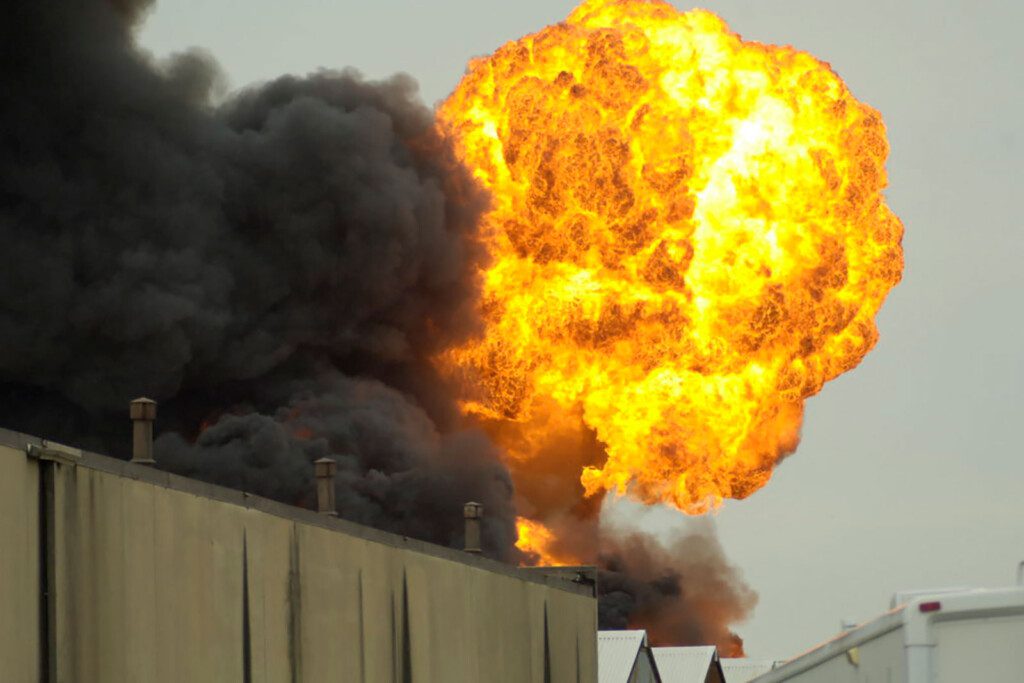
Dust explosions still occur on a regular basis in the process industry causing injuries, fatalities, property damage, business interruption, and environmental pollution.
This is in spite of the wealth and knowledge available to prevent the accident and to reduce the consequences to a minimum.
In this two-day advanced course on dust and powder explosion hazards, you will learn all aspects of dust explosion hazards. The emphasis of this course is dust properties, explosion modelling, preventive measures, ignition sources, protective measures, process hazard analysis, legislation, and case studies.
It enables the attendees to better understand dust hazards, to be able to recognise potentially serious events and to implement effective safeguards against the incident.
The objective of this course is to provide attendees with knowledge on the following topics:
- Dust explosion hazards in the facilities, past accident and international legislation
- Properties of flammable dust that are important to assess hazards
- Dust explosion preventive and protection measures
- How to assess the workplace dust explosion hazards
- How to evaluate the consequence of dust explosion and the protection needs
- Participation in the demonstration of small scale dust explosion
The course is aimed for people who work in chemical, pharmaceutical, food processing, automotive manufacturing, mining and other industries where dust explosion hazards exist.
- Production supervisors and plant managers
- Process and safety engineers
- Chemical engineers
- Mechanical and maintenance engineers
- Safety consultants
- Regulatory body professionals
In general, no special prerequisites are required. However, knowledge in process safety and experience in plant operation will be helpful.
| Time | Agenda |
|---|---|
| Day 1 | |
| 09:00 | Registration and Coffee |
| 09:30 | Opening Why is dust a problem? Statistics on dust explosions: equipment involved, ignition sources, dust types. |
| 09:45 | Dust Explosion Accidents Examples of accidents: Bremer Rolandmühle (Germany, 1979), Jahn Foundry (US, 1999), West Pharmaceutical (US, 2003), Imperial Sugar (US, 2008), Zhongrong (China, 2014), Bosley Wood Flour Mills (UK, 2015) |
| 10:15 | Dust Explosion Basics and Characteristics Combustion mechanisms, explosion properties and test methods, influence factors. |
| 10:45 | Coffee Break |
| 11:00 | Ignition Sources Mechanical sparks, hot surfaces, static electricity, hot work. |
| 12:00 | Lessons Learned: Legislation and Standards International standards and legislation. |
| 12:30 | Lunch |
| 13:30 | Preventive Measures 1: Introduction Inerting, avoidance of ignition sources, housekeeping, hazardous area classification. |
| 14:30 | Preventive Measures 2: Hazardous Area Classification Guidance, important factors to consider, examples. |
| 15:15 | Coffee Break |
| 15:30 | Preventive Measures 3: Avoidance of Ignition Sources Demands for electric and mechanical equipment. |
| 16:15 | Preventive Measures 4: Housekeeping Legislation and industry best practice. |
| 17:00 | End of Day 1 |
| Day 2 | |
| 08:00 | Coffee |
| 08:30 | Protective Measures 1: Introduction Principles of explosion venting, suppression, isolation, and containment. |
| 09:20 | Protective Measures 2: Dust Explosion Venting Design Vent sizing, examples of equipment, vent panels, recoil forces, vent ducts, poor design examples. |
| 10:15 | Coffee Break |
| 10:30 | Protective Measures 3: Dust Explosion Suppression Design Detection, dust reactivity, vessel parameters, hardware examples. |
| 11:00 | Protective Measures 4: Dust Explosion Isolation Slam-shut valves, extinguishing barriers, diverters, rotary valves, explosion flap valves. |
| 11:30 | Lunch |
| 12:30 | Dust Explosion Process Hazard Analysis How to perform a hazard analysis, legislation compliance. |
| 14:00 | Dust Explosion Modelling CFD simulation of explosion propagation, protection design, accident investigation. |
| 15:00 | Q&A Session |
| 15:30 | Small-Scale Dust Explosion Demonstration |
| 16:15 | End of Day 2 |
The enhanced competency on dust explosion of the attending staff will provide organisations with in-house professional knowledge in dust explosion hazard identification and incident prevention.
Attendees will acquire the following skills.
- Identifying dust explosion hazard
- Evaluating the existing protection in the facility
- Applying good practice in explosion accident prevention and protection in the daily work
Attendees will receive a competence certificate by Gexcon at the end of the course.
