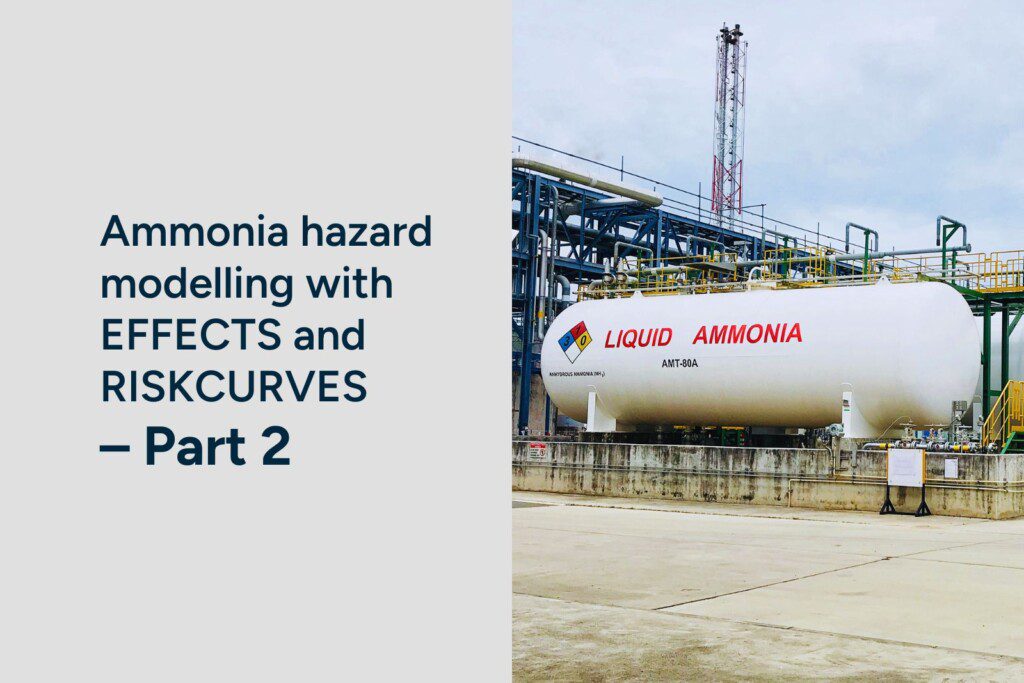
Welcome to the second episode in our series, “Ammonia Hazard Modelling with EFFECTS and RISKCURVES”.
In this episode, Viktoria Boháčiková, Technical Product Specialist, discusses why ammonia safety is critical. She provides an overview of what makes ammonia unique, its dispersion behaviour in gaseous, refrigerated, and pressurised liquefied forms, the hazards linked to its properties, and the potential loss of containment events following an accidental release.
You can watch the episode below or read the full script if you prefer to explore the content in text format.
Video
Script
Hi, I’m Viktoria Boháčiková, Technical Product Specialist at Gexcon, and I would like to welcome you to the second chapter of our video series “Ammonia Hazard Modelling with EFFECTS and RISKCURVES”.
In our first video, we discussed why safety is so important when working with ammonia. Today, we’ll look at ammonia’s unique properties and the hazards we need to manage.
Let’s start with what makes ammonia such a unique substance.
- Ammonia is a colourless gas or liquid with a strong, pungent smell that’s noticeable even at very low concentrations.
- It has a boiling point of −33 °C, allowing it to transition easily between liquid and gas, depending on temperature and pressure.
- When released into the air, ammonia reacts with moisture forming a visible mist or fog made up of ammonium hydroxide droplets.
- It is highly soluble in water, forming an alkaline solution that can be corrosive to certain materials.
- And in its liquefied form, ammonia has high thermal conductivity, making it an effective refrigerant for industrial applications.
Now let’s look at how ammonia disperses after being released.
Ammonia’s dispersion behaviour varies significantly depending on whether it is released as gas or in its liquefied form, primarily due to physical properties and interaction with the environment.
When ammonia is released as a gas, it typically disperses as a buoyant plume because ammonia is lighter than air. In open areas, the gas tends to rise and disperse upwards, reducing ground-level concentrations. However, in confined or enclosed spaces, the gas can accumulate.
Meanwhile, releases of liquefied ammonia involve more complex dispersion behaviour.
Pressurised ammonia rapidly expands upon release and partially vaporises forming a two-phase jet of vapour and liquid droplets. This process, which we call flashing, results in a two-phase cloud. Initially, the ammonia-air mixture can be denser than the surrounding air due to the presence of liquid droplets and cooling effects of rapid evaporation. This density difference causes the cloud to spread laterally near the ground before eventually becoming buoyant as it warms and ammonia droplets evaporate.
In contrast, if cryogenic ammonia is released, most of the content rains out into a pool. The evaporating pool produces ammonia vapour.
Now let’s take a look at ammonia hazards.
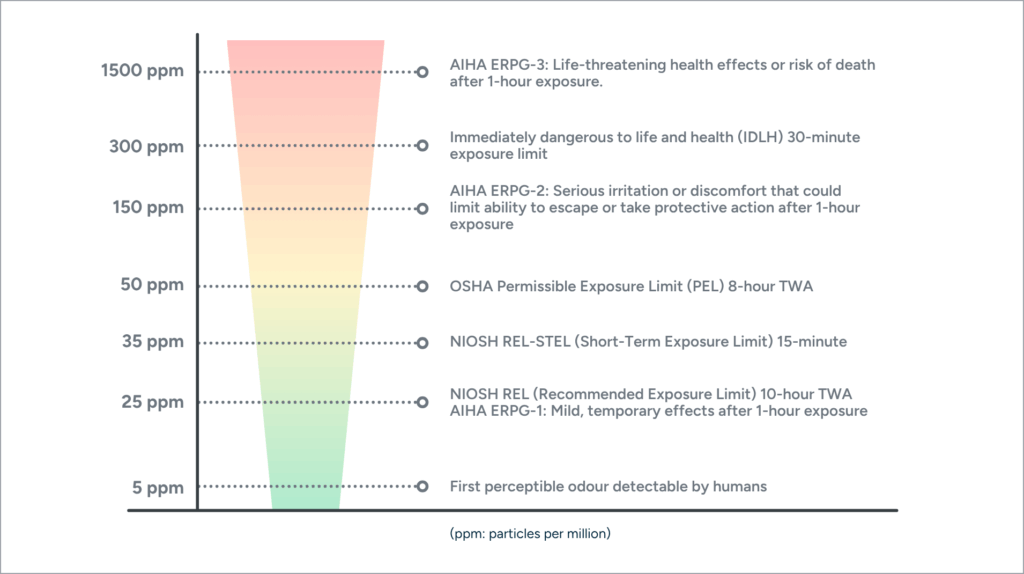
Health effects
- The most significant hazard associated with ammonia is its toxicity.
- When inhaled ammonia gas can cause severe irritation to the nose and throat.
- In extreme cases, it can lead to pulmonary edema, a life-threatening condition where fluid builds up in the lungs.
- Ammonia in its gas or liquid form can burn or freeze the skin, potentially leaving permanent scars.
- And ammonia is also highly corrosive to the eyes, potentially causing permanent damage or even blindness.
- The severity of exposure depends on both the concentration of ammonia and the duration of the exposure.
- This is why safety measures and exposure limits like AEGL, ERPG, or IDHL are important in managing ammonia-related risks.
Flammability
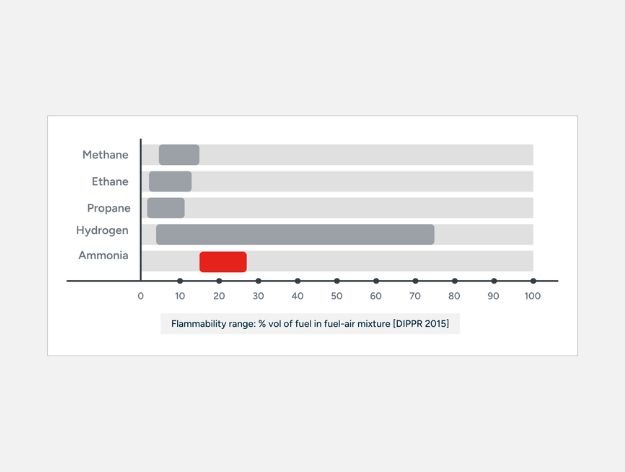
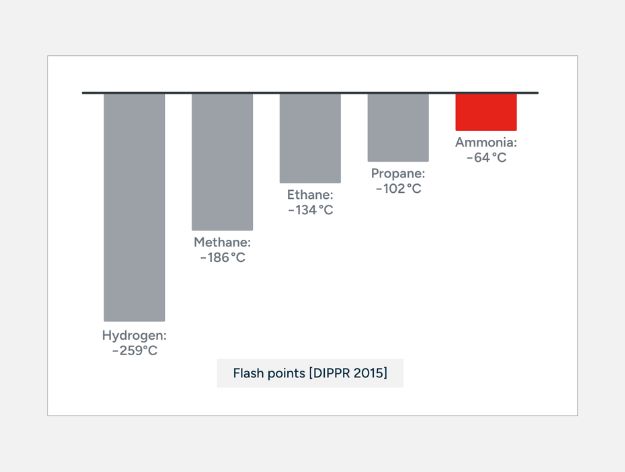
- Also, ammonia is flammable at concentrations between 15 to 28% in air, and it has a high ignition energy and flashpoint.
- However, ammonia is unlikely to ignite spontaneously under normal conditions unless it has been significantly preheated.
- Therefore, fire and explosion hazards are not usually considered in ammonia safety studies.
Environmental impacts
And finally, we must consider ammonia’s impact on the environment.
- When released, ammonia vapour reacts with moisture in the air, eventually returning to the ground as ammonium.
- This can contaminate soil and water sources harming aquatic life and requiring remediation.
- Proper containment and cleanup procedures are critical to minimise these environmental risks.
Now that we understand ammonia hazards, let’s break down the potential events that can occur during a catastrophic rupture or a continuous leak of ammonia.
To help clarify this, I created a loss-of-containment (LoC) diagram specifically for ammonia applications. Let me get you through it step-by-step.
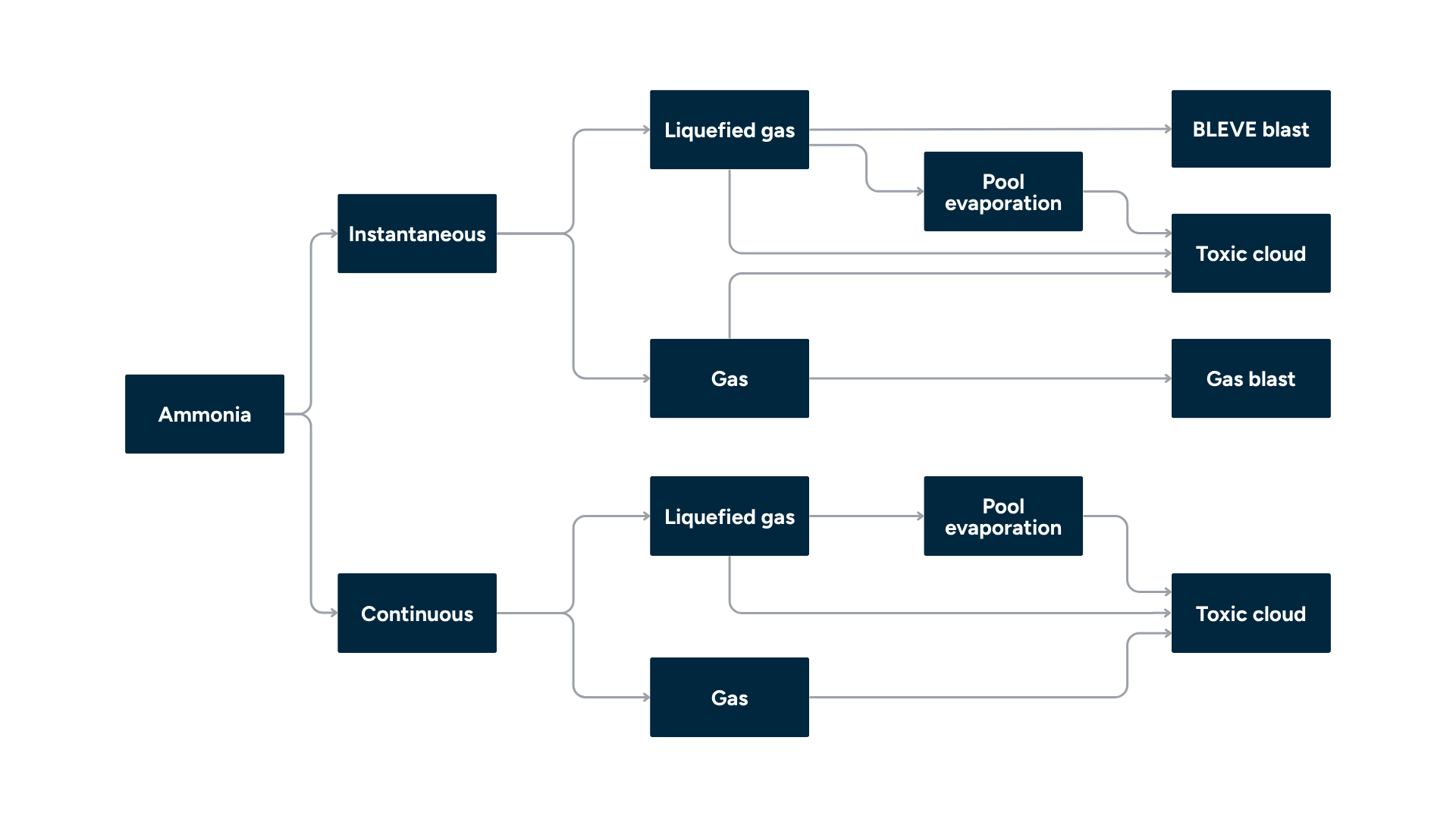
If ammonia is released instantaneously as a pressurised gas or pressurised liquefied gas, and does not ignite, the rupture will cause an overpressure effect. However, the mechanism will slightly differ depending on the state of ammonia.
When a vessel storing pressurised liquefied ammonia burst, rapid depressurisation causes the flashing of a two-phase liquid and vapour mixture. This sudden phase change dramatically increases the volume, generating an overpressure and forming a blast wave.
If the vessel contains only gas, the overpressure results solely from the expansion of the preexisting vapour. This differs from BLEVE as there is no additional flash vaporisation.
Additionally, fragments of the vessel can be propelled over long distances, creating additional dangers for those nearby.
Another important event to always consider during ammonia releases is the formation and dispersion of a toxic cloud. Regardless of whether ammonia is released instantaneously or continuously, this toxic cloud poses a significant hazard.
When ammonia is released, it is typically in its gas or liquefied gas state. When ammonia is released as a gas, it rises quickly because it’s lighter than air. This helps it spread quickly in open areas. But when liquefied ammonia is released, it flashes creating a dense two-phase cloud that stays close to the ground, creating a much greater risk. It can easily move into populated areas, putting people at risk of toxic exposure. This is especially a scenario of concern in places with poor ventilation or high population density.
These hazards emphasise the critical importance of ammonia safety. Understanding these risks is essential to identifying the most effective strategies for preventing and controlling ammonia releases.
One powerful approach for achieving this is hazard modelling.
By simulating various scenarios, we can predict ammonia’s behaviour, evaluate potential outcomes, and implement proactive measures to mitigate risks and enhance safety.
Thank you for watching. I hope this video has provided you with a clear understanding of ammonia’s unique properties and associated hazards.
Stay tuned for the next part we’ll discuss the challenges of modelling ammonia hazards.
See you soon.
About the series
This series looks at the safety and modelling challenges involved in handling ammonia and demonstrates how safety professionals can use Gexcon’s consequence modelling tool EFFECTS and QRA tool RISKCURVES to manage these challenges.
You can access available episodes in this series using the links below.
- Part 1 – Why ammonia safety is critical
- Part 2 – Hazards associated with ammonia
- Part 3 – Ammonia hazard modelling challenges (coming soon)
- Part 4 – Ammonia hazard modelling with EFFECTS (coming soon)
- Part 5 – Ammonia risk assessment with RISKCURVES (coming soon)
Or visit our YouTube playlist.
Have questions about ammonia safety?
If you have any questions about ammonia safety or would like to learn more about ammonia hazard modelling, feel free to reach out to us at info@gexcon.com.
Interested in learning more about ammonia hazard modelling?
Watch a webinar to explore the challenges of accurately modelling ammonia releases and see how advanced tools can overcome them.
Related insights
Browse additional insights to deepen your understanding and stay informed on related topics.
Ammonia hazard modelling
Learn the basics of ammonia hazard modelling and how advanced modelling tools can help assess the risks and consequences of ammonia releases.
Advanced dispersion modelling to support safe energy transition with EFFECTS
Learn about the latest advancements in EFFECTS software’s dispersion modelling and the practical applications in supporting safe energy transition.
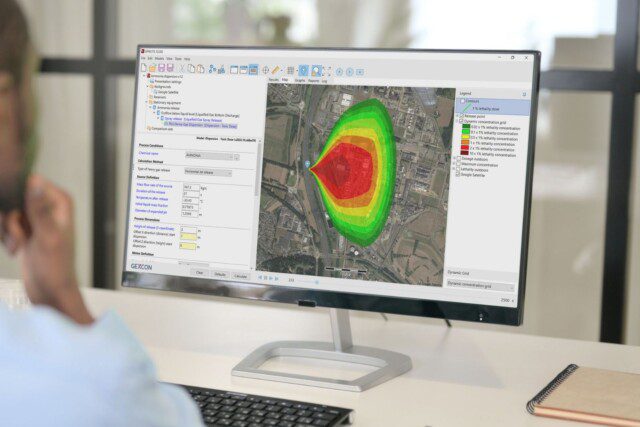
How to simulate ammonia releases
Learn how to simulate ammonia releases using EFFECTS to assess dispersion, toxicity, and support safer design and emergency planning.
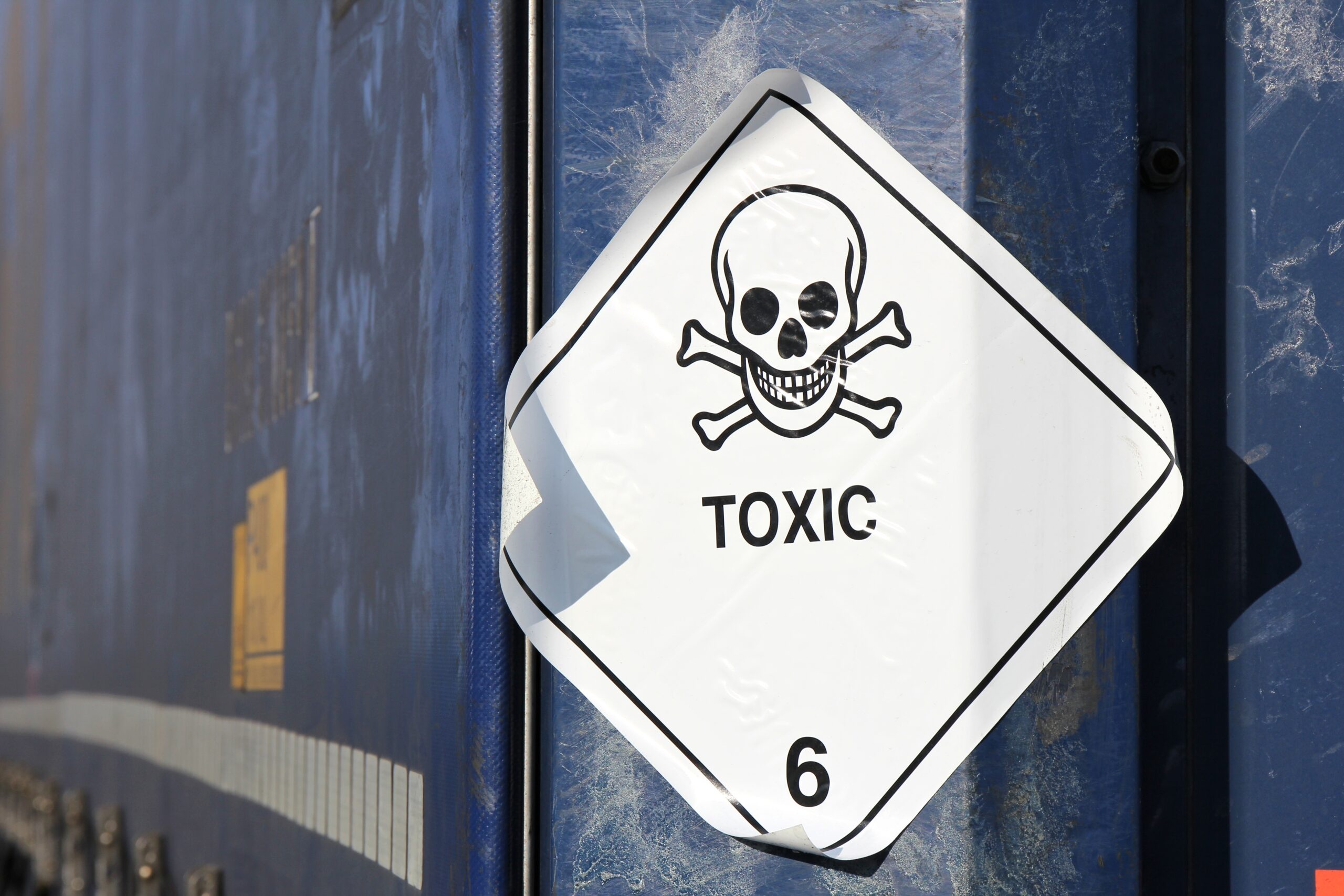
How to model toxic dispersions in EFFECTS
Find out how to model the consequences of atmospheric dispersion for an accidental toxic release with EFFECTS consequence modelling software.
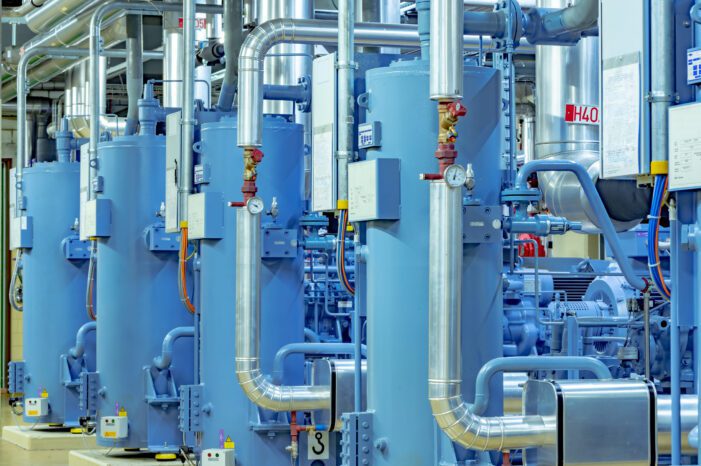
Ammonia Risk Assessments – How advanced consequence modelling can improve safety management
Advanced consequence modelling supports ammonia risk assessments and helps improve safety in storage, transport, and use.
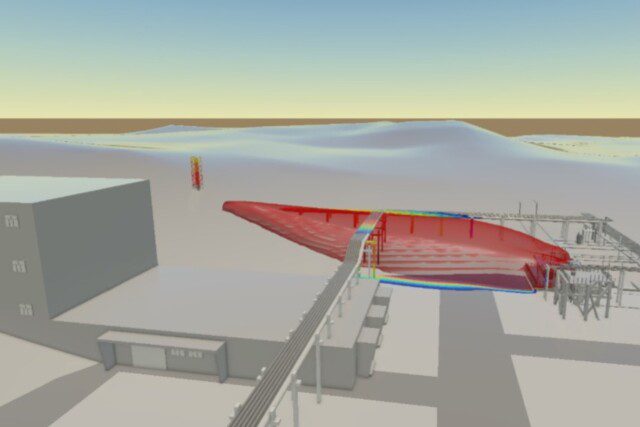
A comparative study: Various modeling approaches for accidental release of ammonia
Find out how different modelling approaches assess ammonia release scenarios and support better risk management decisions.
Stay ahead in process safety and risk management
Get the latest trends in the field of process safety management straight to your inbox, and enhance your skills through knowledge sharing from industry experts.
Subsribe to our newsletter