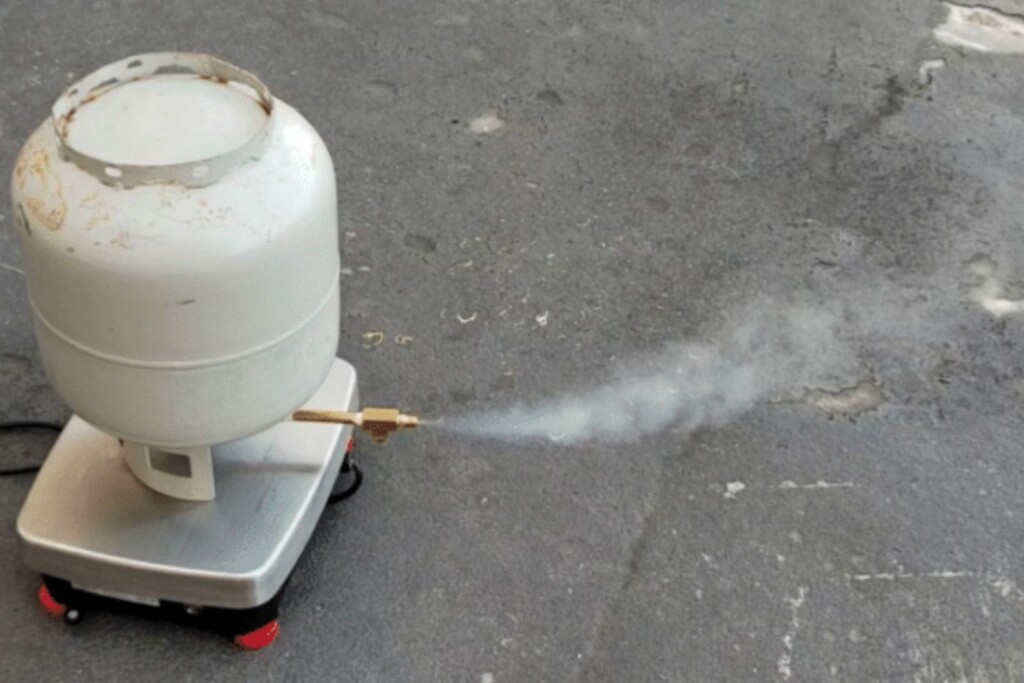
Presented at the International Symposium on Fire Investigation Science and Technology, 2018
When investigating a flash fire or explosion, it is common to test and evaluate the integrity of a fuel gas system – such as LPG systems.
One common technique is to use a pressurised inert gas, such as nitrogen, to not only identify possible holes for propane to leak through but also quantify the flow rate of the leak. However, if the leak is located under the liquid level of the propane cylinder, there is a common misconception that the mass flow rate for a liquid propane release must be approximately 270 times larger than a vapour release through the same hole size.
In a recent case, an investigator concluded that a small hole identified during a leak test using nitrogen gas would be more than sufficient to cause a large flash fire because the hole would have been below the liquid propane level and thus would be 270 times larger than a vapour propane leak through the same hole. This misconception regarding the magnitude of liquid propane leaks stemmed from the fact that liquid propane has a density that is approximately 270 times larger than the density of gaseous propane at atmospheric pressure and temperature.
Under practical conditions, the mass flow rates of liquid propane will actually be much closer to those of vapour releases given identical hole sizes. In fact, the difference will be only approximately 6-8 times larger if both liquid and gaseous propane are stored at ambient temperatures of 20°C. This near 30-fold reduction in liquid flow is due to how propane is stored and the physics governing a compressible vapour release compared to an incompressible liquid release. More specifically, for propane at 20°C the vapour will exit a small hole at the speed of sound and due to the high storage pressure (e.g., approximately 105 psig at 20°C) the density of the vapour leaking will be much higher than atmospheric conditions. Conversely, an incompressible liquid will be limited by the pressure difference upstream and downstream of the hole.
The present study demonstrates the differences in liquid and vapour propane release rates and shows that liquid releases are not 270 larger than vapour releases. This is accomplished by:
(1) providing an overview of the theoretical orifice flow equations for pressurised vapour and liquid releases;
(2) presenting results from actual releases of liquid and vapor propane from a 120-gallon water capacity tank and a 20 lb cylinder; and
(3) presenting CFD results that highlight the importance of accurate estimates of leak rates when it comes to formulating origin and cause hypotheses.
Would you like to learn more about this topic?
Read the full paper or contact us to learn more.
Authors

Scott G. Davis, Ph.D., P.E., CFEI
US CEO – Principal Engineer at Gexcon

John Pagliaro, Ph.D., P.E., CFEI
Senior Managing Engineer at Gexcon

Tom DeBold, P.E., IAAI-CFI, CFEI
Managing Forensic Engineer at Gexcon
Related insights
Browse additional insights to deepen your understanding and stay informed on related topics.
Key lessons from LNG incidents for safer operations
Lessons learnt from past LNG incidents, such as the Cleveland Disaster, the Skikda Explosion, and the Plymouth Plant Incident.
Learning from a propane cylinder BLEVE incident
Due to propane’s characteristics, there are safety-critical design features and procedures that should be implemented in the propane industry to ensure the safe use of propane.
Learning from ammonium nitrate explosion incidents
Ammonium nitrate is stable, but bulk storage near fire hazards can lead to major explosions despite long-known safety risks.
How to properly design your dust explosion protective systems
Learn how poor dust system design led to a major plant explosion and what steps to take to prevent similar combustible dust incidents.

Unraveling the mysteries of ammonium nitrate detonations
Learn how to prevent ammonium nitrate incidents by understanding the conditions that lead to explosive decomposition and how to avoid them.
Lessons learned from LNG incidents
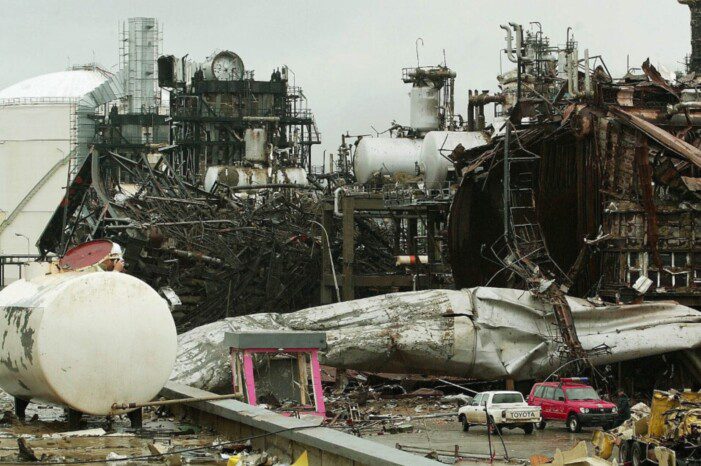
Learn about the importance of safety in LNG facilities by examining lessons from the 2004 Skikda LNG liquefaction facility explosion and the 1944 Cleveland Disaster.
Stay ahead in process safety and risk management
Get the latest trends in the field of process safety management straight to your inbox, and enhance your skills through knowledge sharing from industry experts.
Subsribe to our newsletter