Welcome to the fifth and final episode of our series, “CO2 Hazard Modelling with EFFECTS and RISKCURVES for CCUS Pipeline Transportation.”
In this episode, Sonia Ruiz Pérez, Product Manager of EFFECTS and RISKCURVES, explains how the RISKCURVES Quantitative Risk Assessment (QRA) software complements the EFFECTS consequence modelling tool in analysing the risk of CO2 transport for CCUS projects.
You’ll discover the key features of RISKCURVES for CO2 risk assessment, with real examples shown through video clips and snapshots of the software in action.
Watch the last episode below or read the full script if you prefer to explore the content in text format.
Video
Script
Hello everyone. I’m Sonia Ruiz Pérez, the EFFECTS and RISKCURVES Product Manager, and I would like to welcome you to the final part of our video series, “CO2 Hazard Modelling with EFFECTS and RISKCURVES for CCUS Pipeline Transportation”.
In the previous video, we explored how the EFFECTS consequence modelling software addresses the challenges of CO2 modelling.
In this video, we will dive into how you can use RISKCURVES to complement EFFECTS in analysing the risk of CO2 transport for CCUS projects.
But first, let me give you a brief introduction to RISKCURVES for those who may not be familiar with it.
RISKCURVES is a powerful tool, specifically designed for comprehensive Quantitative Risk Assessments for the storage and transportation of dangerous goods.
It evaluates various key risk metrics, including:
- Individual Risk (LSIR – Location-Specific Individual Risk),
- IRPA (Individual Risk Per Annum),
- Societal Risk, and
- Consequence Risk
which allow the quantification of risk.
But how can you use RISKCURVES to complement EFFECTS in assessing CO2 risks?
RISKCURVES helps you determine whether specific scenarios exceed acceptable thresholds, helping you identify areas that require mitigation or prevention measures.
- Solution 1 – Societal Risk maps
One of RISKCURVES’ standout features is the Societal Risk map, which allows you to visualise the risk distribution geographically. This is especially useful for assessing risks in pipeline transportation activities or taking informed decisions on land use planning.
- Solution 2 – Seamless integration with EFFECTS
Another advantage of using RISKCURVES is its seamless integration with EFFECTS. All models in EFFECTS are directly accessible within RISKCURVES, allowing you to access consequence and risk modelling results within the same tool, that way streamlining your workflow.
- Solution 3 – Use consequence results from any modelling tools
Additionally, RISKCURVES supports the import of results from other consequence modelling software tools, including Gexcon’s CFD tool, FLACS. This integration allows you to perform CFD-based calculations in FLACS, such as dispersion simulations that account for how the flow interacts with surrounding buildings and structures, and export those results using the FLACS2RC tool for use in Quantitative Risk Assessments within RISKCURVES.
Before we wrap up, let me show you some snapshots from RISKCURVES to illustrate examples of various risk criteria calculations.
- [Preview at 02:40] – Consequence data for risk assessment
- [Preview at 02:53] – Defining the CO2 pipeline route using coordinates by clicking directly on the map
- [Preview at 03:15] – Analysing LSIR
- [Preview at 03:35] – Analysing IRPA using building and role definition
- [Preview at 05:14] – Analysing Societal Risk with fN curves and Societal Risk maps
- [Preview at 05:53] – Analysing Consequence Risk
- [Preview at 06:25] – Using the Export Tool to export all input data and results at once into a Word document with a single click
By using RISKCURVES, you can gain valuable insights into various risk factors, helping you identify high-risk scenarios that require immediate attention. This empowers you to prioritise safety measures effectively, allocate resources efficiently, and optimise costs without compromising safety.
I encourage you to explore RISKCURVES and experience its full capabilities firsthand.
To help you get started, you can access a series of project examples showcasing the software in action. These examples provide practical insight into how RISKCURVES can assist with CO2 hazard modelling for CCUS pipeline transportation.
To view these RISKCURVES files, you can use the commercial version if you already have a licence or download the free demo version of the software.
This demo version is available on Gexcon’s website and allows you to view pre-calculated projects at no cost.
This video marks the conclusion of our series “CO2 Hazard Modelling with EFFECTS and RISKCURVES for CCUS Pipeline Transportation”. I hope you found these videos informative and that they have inspired confidence in how EFFECTS and RISKCURVES can support the safety assessments of your CCUS projects.
If you have any questions or need further information, please don’t hesitate to reach out to us at effects@gexcon.com.
I look forward to sharing more video series with you, showcasing the capabilities of EFFECTS and RISKCURVES in addressing various hazard modelling challenges.
Stay tuned, and I’ll see you next time.
About the series
This series explores the safety and modelling challenges of transporting carbon dioxide (CO2) through pipelines in CCUS technology and showcases how safety professionals can use EFFECTS and RISKCURVES software tools to address these challenges.
You can access the available episodes below:
- Part 3 – CO2 hazard modelling challenges
- Part 4 – CO2 hazard modelling with EFFECTS
- Part 5 – CO2 risk assessment with RISKCURVES
Have questions about RISKCURVES for CO2 applications?
If you have any questions about CO2 risk assessments with RISKCURVES, please feel free to contact us at effects@gexcon.com.

Interested in learning more about CO2 hazard modelling?
Watch our webinar to explore the challenges of accurately modelling CO2 releases and see how advanced tools can overcome them.
Related insights
Browse additional insights to deepen your understanding and stay informed on related topics.
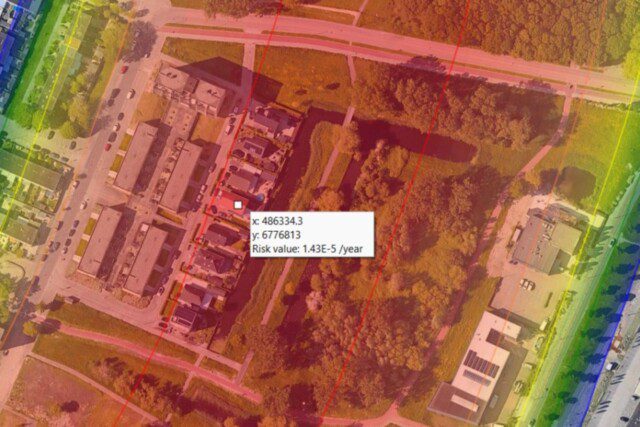
CCS risk assessment: Analysing IRPA and LSIR for pipelines transporting CO2
Analysing risks with RISKCURVES for buried pipelines transporting CO2, focusing on Individual Risk criteria LSIR and IRPA.

Hazardous Area Classification in Carbon Capture, Utilisation, and Storage (CCUS)
Learn how hazardous area classification (HAC) zoning and risk assessments support safety in CCUS infrastructure.

CO2 hazards in Carbon Capture, Utilisation, and Storage (CCUS)
An overview of the key safety concerns related to CO2 in CCUS technology, examples of accidents involving large CO2 releases, and safety measures.
CO2 hazard modelling
This webinar discusses CO2 hazard modelling and demonstrates how advanced tools can be used to accurately assess and mitigate CO2 risks.

Modelling CO2 releases in CCUS with EFFECTS
This white paper explores how EFFECTS consequence modelling software supports safety engineers, risk analysts, and project managers in modelling CO2 release scenarios.
CO2 hazard modelling with EFFECTS
The fourth episode explains how the EFFECTS consequence modelling software helps address the CO2 hazard modelling challenges.
CO2 hazard modelling challenges
This third episode discusses the challenges in modelling CO2 releases, including its multiphase nature, the impact of craters when pipelines are buried, dense gas behaviour, and more.
Hazards associated with CO2 pipeline transportation
This episode discusses the fundamental properties of CO2 and the hazards associated with CO2 pipeline transportation.
Stay ahead in process safety and risk management
Get the latest trends in the field of process safety management straight to your inbox, and enhance your skills through knowledge sharing from industry experts.
Subsribe to our newsletter